

Reviewed · EDGE & HUDSON YARDS
Secrets of Hudson Yards and the Edge: A walking tour
Hudson Yards looks like a polished city of glass, steel, and very expensive apartments. This tour asks what lies behind that shine: who paid for it, what went wrong along the way, and why this new neighborhood has become one of Manhattan’s most debated projects.
I like the tour’s non-corporate point of view and its focus on architecture you can see but may not understand. I also like that it connects The Vessel and The Edge to bigger questions about public space, private money, engineering, and New York’s future. The main drawback is time: the walking route is described as a one-day activity for booking purposes, but the actual tour takes about an hour, which may feel short for the amount of material covered.
In This Review
- Key points to know before you book
- Why Hudson Yards needs a walking tour
- Starting at 30 Hudson Yards and The Edge
- Secret passageways and unusual public spaces
- The Vessel, art, and the cost of spectacle
- How the money built the neighborhood
- A park named for a fierce fighter for the poor
- Ending at Mercado Little Spain
- How long the walk really feels
- Who will get the most from this tour
- Price, accessibility, and booking flexibility
- Should you book Secrets of Hudson Yards and The Edge?
- FAQ
- Where does the tour begin?
- Where does the tour finish?
- How long does the walking tour last?
- Is admission to The Edge included?
- Does the tour visit The Vessel?
- What language is the tour conducted in?
- Is the tour wheelchair accessible?
- How much does the tour cost?
- Can I cancel the booking?
Key points to know before you book
- Hear the untold side of Hudson Yards: Expect stories about money, disappointment, death, and the powerful interests behind Manhattan’s newest neighborhood.
- See The Vessel and The Edge from a different angle: The guide explains the ideas, engineering, and controversy behind these famous structures, not just where to take a photograph.
- Look for unusual design details: The walk includes secret passageways, moving performance spaces, dancing skyscrapers, and a tower described as a 1,000-foot-tall vine.
- Learn from a passionate local guide: Matthew leads the walk and brings strong knowledge of New York history, architecture, and the forces shaping the city.
- Finish at Mercado Little Spain: The tour ends near the Spanish food hall and restaurants founded by José Andrés, Ferran Adrià, and Albert Adrià.
Why Hudson Yards needs a walking tour

Hudson Yards is easy to visit badly. You can arrive by subway, snap a picture of The Vessel, ride up to The Edge, and leave with a handful of impressive images. What you may miss is the strange story underneath the polished surfaces.
This district was built over active railroad tracks on Manhattan’s far West Side. That simple fact explains much of its price, engineering, and appearance. The neighborhood had to be constructed above the rail yards, turning the ground itself into a major technical problem. Architects and engineers had to create a platform strong enough to support office towers, apartments, shops, public spaces, and heavy public art.
The tour gives you a way to read those details. I like that it treats Hudson Yards as more than a collection of new buildings. You hear about the financing, the ambitions behind the project, and the people who hoped to turn an underused part of Manhattan into a new center of business and entertainment.
You also hear about the gap between promise and result. The gleaming towers suggest certainty and success, but the story includes delays, criticism, disappointment, and human cost. That contrast gives the walk its edge. It is not an official sales pitch, and it does not ask you to admire every decision made here.
More Edge and Hudson Yards tickets:
- New York Explorer Pass: Top Attractions including Edge
★ 4.6 · 7,872 reviews - New York Pass®: 100+ Attractions including Edge NYC
★ 4.6 · 2,465 reviews - NYC Edge Observation Deck at Hudson Yards Admission Ticket
★ 4.0 · 2,242 reviews
Starting at 30 Hudson Yards and The Edge
The tour begins in front of the office entrance to 30 Hudson Yards, at West 33rd Street and Hudson Boulevard East. This is a practical meeting point because 30 Hudson Yards is the tower that contains The Edge, the neighborhood’s famous observation deck.
The first part of the walk sets up the district. You learn how Hudson Yards was planned and how the project came to life above the railroad tracks. The guide also introduces the competing visions for the area and the enormous sums required to make those visions real.
One of the tour’s central questions concerns The Edge itself. The observation deck is marketed as being on the 100th floor, but the guide explains what floor it is really on. That may sound like a small bit of trivia, but it fits the tour’s larger purpose: the wording used to sell Hudson Yards is not always as simple as it appears.
You should understand that this walking tour does not appear to include admission to The Edge. You see and discuss the tower, but the experience is about the neighborhood around it rather than a visit to the observation deck itself. If you want to go up, plan that as a separate activity.
The opening section also places 30 Hudson Yards beside its neighbors. The buildings here are not simply tall boxes. Their shapes, angles, and surfaces were chosen to create a particular image of modern New York. The guide points out the design choices and explains how architecture helps sell the idea of a new district.
Secret passageways and unusual public spaces
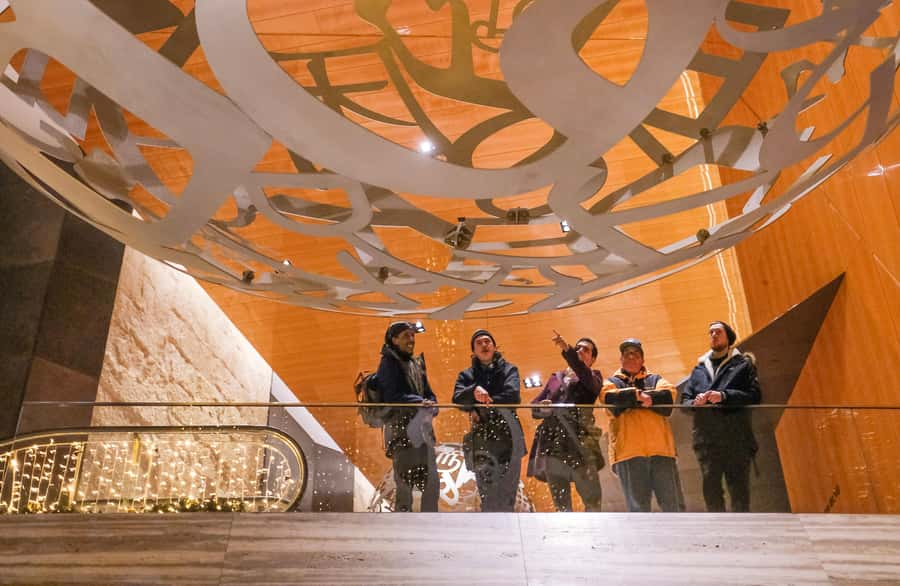
The route includes several short stops that are not obvious from a quick visit. Some are described as secret passageways or less-publicized corners of Hudson Yards. These stops help you see how people move through the complex and how public space works in a neighborhood built by private developers.
I especially like this part of the tour because it rewards attention. The biggest buildings are hard to miss, but smaller connections can tell you just as much about a project. A passageway, a viewpoint, or a carefully placed piece of public art may reveal how Hudson Yards tries to direct your eyes and your feet.
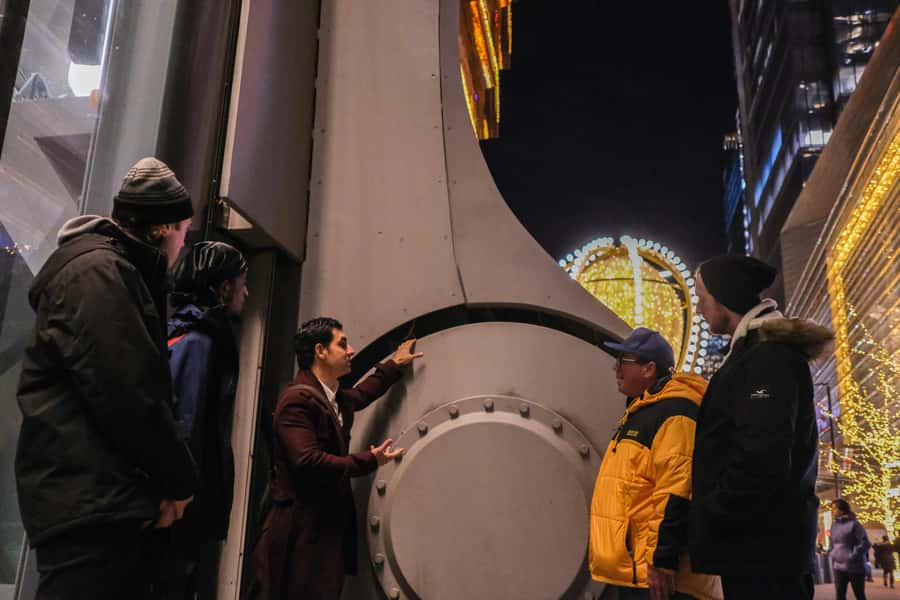
The tour also covers a giant performance space built on massive wheels. This is one of the district’s more unusual engineering ideas. Rather than treating entertainment as something that happens inside a fixed theater, the design allows a huge performance venue to move.
That concept says a lot about Hudson Yards. The district is not only trying to provide offices and homes. It wants to become a destination for culture, shopping, dining, and large public events. The guide connects these details to the question of what the neighborhood may become in the years ahead.
You may also hear about a plant-covered skyscraper described as a 1,000-foot-tall vine. This is a good example of the tour’s style. The buildings are presented not just as real estate, but as giant design statements. Their shapes are meant to create emotion and recognition, even when the practical purpose is less obvious.
Because the stops are short, keep your attention on the guide rather than expecting long pauses at each place. Several stops last only five or ten minutes. The pace is designed to keep you moving through the district, so this is a better fit for someone who enjoys a guided overview than for someone who wants to study each building at length.
The Vessel, art, and the cost of spectacle
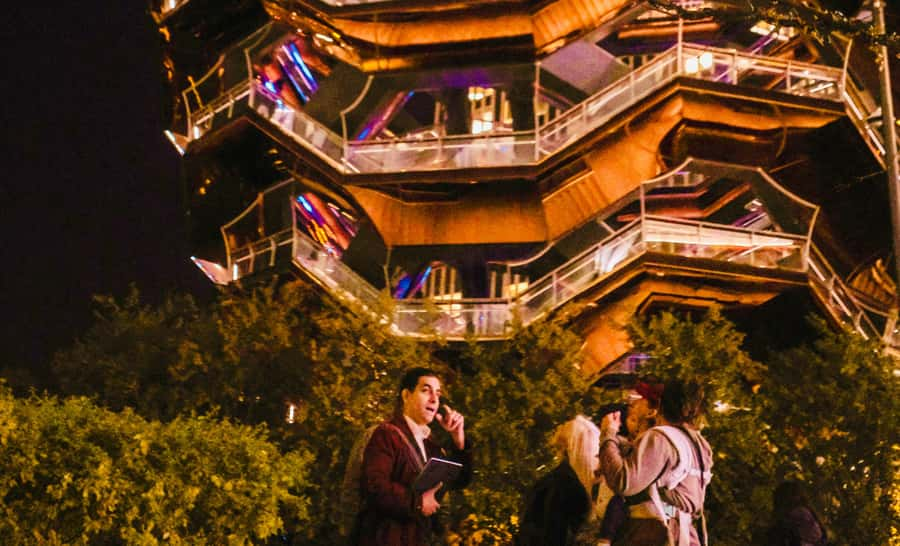
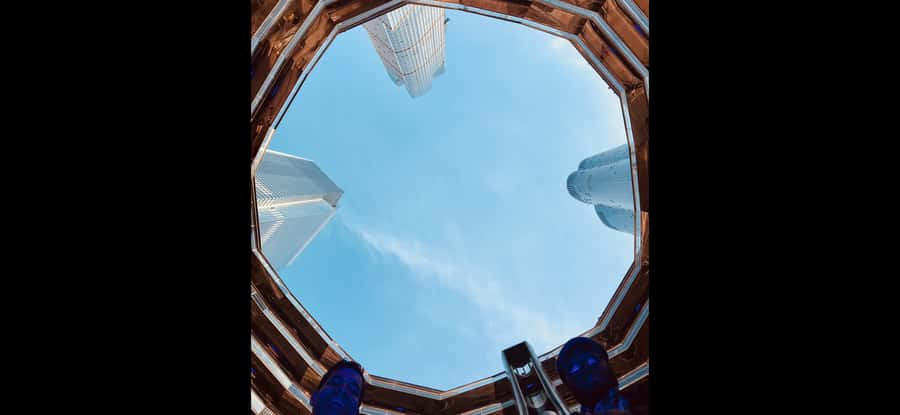
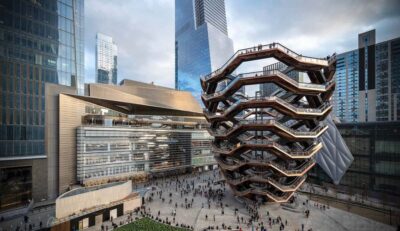
The Vessel is the most instantly recognizable structure in Hudson Yards. Its bronze-colored lattice rises like an enormous honeycomb of stairs. The tour gives you time to see it and explains the story behind the design and the ideas that shaped it.
The structure was intended to be more than a sculpture. Its many stairways and platforms were designed to give people changing views of one another, the plaza, and the surrounding buildings. It is an object that depends on human movement. You understand it better when you think about how people occupy it, not just how it looks in a photograph.
The guide also addresses the darker side of The Vessel’s story. That matters because Hudson Yards is presented as a place of celebration, but public spaces can carry real responsibilities. The tour’s willingness to discuss disappointment and death keeps the visit from becoming a simple celebration of billion-dollar design.
At the time of your visit, access arrangements for The Vessel may differ from the building’s original concept. The supplied tour information promises the story behind the work, not a climb through it, so you should treat The Vessel stop as sightseeing and interpretation.
Public art is a major part of Hudson Yards. The tour points to work by famous and revolutionary artists and explains how art helps shape the identity of the district. You will see how the developers used art to give the new neighborhood a sense of place from its earliest days.
I find this useful because public art here is not an afterthought. It is part of the project’s public face. At the same time, the tour encourages you to ask who gets to decide what counts as public space when the surrounding land and buildings are tied to private investment.
More New York City walking tours:
- SoHo, Little Italy, and Chinatown Walking Tour in New York
★ 5.0 · 3,153 reviews - Secrets of Grand Central Station Walking Tour New York City
★ 5.0 · 1,796 reviews - Greenwich Village Walking and Food Tasting Tour
★ 5.0 · 1,572 reviews - Artistic, Alternative Greenwich Village Walking Tour
★ 5.0 · 971 reviews
How the money built the neighborhood
The financial story is one of the strongest reasons to choose this tour. Hudson Yards is often described as the biggest private real estate development in American history. That scale makes the question of funding unavoidable.
The guide explains where the money came from and how the project was made possible. You learn about the relationship between public infrastructure and private development, particularly the role of the rail yards and the platform constructed above them.
This is where the tour becomes useful for anyone interested in cities. A new neighborhood does not appear simply because an architect draws attractive towers. It requires transport links, zoning decisions, financing, engineering, political support, and a plan for attracting companies, residents, shoppers, and cultural events.
The tour also asks if Hudson Yards could become the Las Vegas of Manhattan. That comparison points to the district’s plans for spectacle and entertainment. A giant observation deck, monumental art, luxury retail, high-rise hotels, restaurants, and performance venues can create a destination that competes for attention with Times Square and other major New York attractions.
You do not have to agree with the comparison to find it useful. It gives you a way to think about Hudson Yards as an entertainment project as well as a business district. The question is whether the neighborhood will feel like a genuine part of New York or a carefully managed attraction built for visitors and wealthy tenants.
A park named for a fierce fighter for the poor

The walk also introduces the feminist figure honored by one of Hudson Yards’ parks. She fought for poor Americans, and her name adds a social and political layer to a district often associated with corporate power and luxury.
This is an important counterpoint. Hudson Yards can look like a place created by developers for the rich, so a park named for a woman who fought for poor people changes the conversation. It reminds you that New York’s public spaces carry memories and arguments that do not always match the image of the surrounding buildings.
The tour does not treat the neighborhood as an isolated construction site. It links Hudson Yards to wider American questions about inequality, public benefit, private wealth, and who gets represented in the city.
For me, these connections make the walk more worthwhile than a purely architectural tour. You still learn about buildings and engineering, but you also get a sense of the values competing for space in modern Manhattan.
Ending at Mercado Little Spain

The walk finishes at Mercado Little Spain, a Spanish food hall and restaurant complex founded by José Andrés, Ferran Adrià, and Albert Adrià. This is a fitting end because food offers a more human way to experience a district dominated by towers.
The guide introduces the market’s restaurants and the Spanish culinary ideas behind them. You also hear about José Andrés’ work providing fresh meals during humanitarian crises around the world. That detail broadens the discussion beyond dining and connects the destination to food relief and public service.
Mercado Little Spain gives you a chance to continue the visit on your own. You can eat, look around, or use the ending point as a launchpad for more time in Hudson Yards. The tour does not include a meal, so budget separately if you plan to stop for food.
Finishing here also creates a useful contrast. The towers represent global finance, private development, and high technology. The market presents culture through cooking, shared tables, and recognizable regional traditions. Both are part of the district’s effort to persuade you that Hudson Yards is more than an office complex.
How long the walk really feels
The route includes roughly a dozen stops, with guided sections lasting from about five to ten minutes. That makes the experience compact and fairly focused. You move from 30 Hudson Yards through viewpoints, architectural details, The Vessel, public art, and less obvious corners before finishing at Mercado Little Spain.
The practical issue is the total time. One confirmed participant found the tour too short at about one hour. I would take that comment seriously. The walk covers a lot, but it does so at a brisk clip, and each subject could easily support a much longer discussion.
That short length can also be an advantage. If you have only a morning or afternoon in Midtown, the tour gives you an organized introduction without consuming half your day. You can then visit The Edge separately, eat at Mercado Little Spain, or continue toward the High Line and the wider West Side.
The activity page labels the duration as one day for scheduling purposes, but the actual guided walk is about an hour. Check the available starting time when you book and plan your day around a short walking tour, not a full-day excursion.
Who will get the most from this tour

I would choose this walk if you like cities as working systems rather than just collections of sights. It suits you if you want to know how a major development was financed, how engineers handled the rail yards, and why certain buildings look so unusual.
It is also a good match if you have already seen photographs of The Vessel and The Edge but want context. The guide focuses on stories that official promotional material is unlikely to emphasize, including disputes, failures, and the human cost connected with the district.
Architecture students, urban planners, photographers, and New York regulars should find plenty to think about. So should anyone curious about the way private money changes public space.
I would be less likely to recommend it if you want a long stop at each landmark, a visit inside The Edge, or a relaxed food tour. The pace is short and information-heavy. You need to listen while walking, and some stops are brief.
Matthew is the guide named in the available information. He previously led a Gilded Age mansion tour and brings a strong passion for New York and its past. His approach appears to suit people who enjoy asking questions, since the tour is designed to explain details rather than simply point them out.
Price, accessibility, and booking flexibility
At $40 per person, the value depends on what you want from Hudson Yards. If you only need directions and photographs, it is expensive for an hour. If you want a live guide to explain the project’s financing, design, public art, political context, The Vessel, The Edge, and the neighborhood’s possible future, the price is reasonable.
You are paying for interpretation, not admission tickets. The Edge is discussed but not included as an observation-deck visit, and food at Mercado Little Spain is also separate.
The tour is conducted in English and is wheelchair accessible. Smoking is not allowed. You can cancel up to 24 hours in advance for a full refund, and the reserve-now, pay-later option can help if your New York schedule is still changing.
Should you book Secrets of Hudson Yards and The Edge?
Book it if you want to understand why Hudson Yards looks the way it does. The best parts are the guide’s explanation of the money and engineering, the unusual design details, the frank discussion of The Vessel, and the larger question of whether Manhattan is creating a new kind of entertainment district.
Keep your expectations in check about duration. This is an approximately one-hour walking introduction, not a full-day exploration and not a ticket to The Edge. If you pair it with the observation deck, The Vessel area, the High Line, and lunch at Mercado Little Spain, it can become the backbone of a rewarding half-day on the West Side.
At $40, I would book it for the stories and the questions it raises. Skip it if you only want photographs. Choose it if you want the shiny towers to make more sense.
FAQ
Where does the tour begin?
The tour begins in front of the office entrance to 30 Hudson Yards, at the corner of West 33rd Street and Hudson Boulevard East.
Where does the tour finish?
The tour finishes at Mercado Little Spain in Hudson Yards.
How long does the walking tour last?
The guided walk takes about one hour. The activity is labeled as lasting one day for booking purposes, so check the available starting times when reserving.
Is admission to The Edge included?
No. The tour explains The Edge and discusses what floor the observation deck is really on, but the supplied information does not include admission to the observation deck.
Does the tour visit The Vessel?
Yes. The route includes sightseeing at The Vessel and explains the story behind the structure.
What language is the tour conducted in?
The live tour is conducted in English.
Is the tour wheelchair accessible?
Yes, the activity is listed as wheelchair accessible.
How much does the tour cost?
The price is $40 per person.
Can I cancel the booking?
Yes. You can cancel up to 24 hours in advance for a full refund. A reserve-now, pay-later option is also available.
Just listed around New York City
- American Museum of Natural History and MOMA Combo Tickets★ 4.5 · 3 reviews
- Greenwich Village Private Walking Tour★ 5.0 · 3 reviews
- New York City: Panoramic Skyline Tour★ 5.0 · 3 reviews
- NYC: See 30+ Top Sights in One Day – Kids Join Free!★ 5.0 · 3 reviews
- NYC Private Custom Tour by a Local Guide, off-the-beaten-path★ 5.0 · 3 reviews
- NYC Sip ‘N Groove Cruise with DJ★ 3.5 · 3 reviews
- SUCCESSION Walking Tour of Downtown Manhattan Filming Locations★ 5.0 · 3 reviews
- NYC: Private Walking Tour of Donald Trump Buildings★ 5.0 · 3 reviews
Edge & Hudson Yards, compared.

New York Explorer Pass: Top Attractions including Edge
Read our review →
New York Pass®: 100+ Attractions including Edge NYC
Read our review →
NYC Edge Observation Deck at Hudson Yards Admission Ticket
Read our review →
Go City: New York Explorer Pass: 100+ Things to Do Including Edge
Read our review →

Pick 1 Attraction + Edge New York + Top of the Rock
Read our review →
Hudson Yards & High Line Tour with Optional Edge Ticket
Read our review →Browse the lists this tour appears in