
Reviewed · TIMES SQUARE & MIDTOWN TOURS
Midtown Manhattan Art and Architecture Walking Tour
Midtown Manhattan looks familiar until you start noticing the art in corporate lobbies, the passageways tucked between office towers, and the zoning rules that shaped the skyline. This small-group walking tour connects Times Square, Rockefeller Center, St. Patrick’s Cathedral, Park Avenue, and Billionaire’s Row through art, architecture, and city planning.
I like the intimate size, capped at five people, and I like the tour’s unusual route through privately owned public spaces, office lobbies, arcades, and buildings you might pass without a second glance. Guide Robert Amell, also called Rob, brings a personal, flexible touch, but keep in mind that some indoor spaces can close for holidays or other reasons, so the route may change.
In This Review
- Key points at a glance
- Why this Midtown walk feels different
- From Eighth Avenue to Times Square’s north edge
- The Brill Building and Midtown’s culture machine
- Corporate art inside 787 Seventh Avenue
- UBS, Time and Life, and the power of scale
- McGraw Hill, Skyscraper Alley, and Rockefeller Center
- St. Patrick’s Cathedral and Fifth Avenue’s changing face
- Park Avenue from rail tracks to corporate towers
- Madison Avenue, sculpture, and holdout buildings
- Ending beneath Billionaire’s Row
- Is $59 a fair price?
- Practical advice before you go
- Who should book this walk?
- FAQ
- How long is the Midtown Manhattan Art and Architecture Walking Tour?
- How many people can join the tour?
- What is the tour price?
- Where does the tour begin?
- Where does the tour end?
- What language is the tour offered in?
- Can the route change if indoor spaces are closed?
- Should you book it?
Key points at a glance
- Only five people maximum: You get room to ask questions and keep a comfortable walking pace.
- A fresh look at Midtown: The route links Times Square, Rockefeller Center, Park Avenue, and Billionaire’s Row.
- Art beyond the museum: See works by Roy Lichtenstein, Sol LeWitt, Frank Stella, Sarah Morris, Fritz Glarner, and others.
- Architecture with a reason behind it: Zoning laws, holdout buildings, corporate plazas, and private public spaces explain why Midtown looks the way it does.
- A flexible guide-led experience: Rob may adjust the route, add a stop, or offer a variation when interior spaces are closed.
- Good value for art and city-planning fans: At $59, the price is modest for a private-feeling tour lasting about 2 to 3 hours.
Why this Midtown walk feels different
Many Manhattan walking tours point out famous buildings and move on. This one asks why those buildings are there, why some skyscrapers taper while others rise straight up, and how private companies came to provide public spaces in the middle of dense Midtown.
You begin near the old boundary between Hell’s Kitchen and Times Square, then follow the city’s move uptown through several eras. The story moves from Beaux-Arts decoration to Art Deco geometry and then to the clean lines of Modern architecture. Along the way, art is not treated as a separate subject. It becomes part of the explanation for how offices, plazas, hotels, churches, theaters, and transportation spaces work together.
That approach suits you if you enjoy city details that are easy to miss. You may enter a lobby you would normally ignore, look down at a subway station with new eyes, or pause in a narrow mid-block arcade created by a zoning quirk.
The tour runs in English, with morning and afternoon departures. It operates in all weather, so comfortable shoes and suitable clothing matter. You need a moderate level of fitness, though the guide is attentive to pace and restroom breaks. The small group makes this much more personal than a standard city walk.
More Times Square and Midtown walks:
- NYC: Circle Line “The Beast” Midtown/Downtown Speedboat Ride
★ 4.6 · 4,259 reviews - NYC in a Day Tour: Lady Liberty, Times Square, Freedom Tower
★ 5.0 · 1,735 reviews - Broadway and Times Square Insider Tour with Theater Professional
★ 5.0 · 651 reviews
From Eighth Avenue to Times Square’s north edge
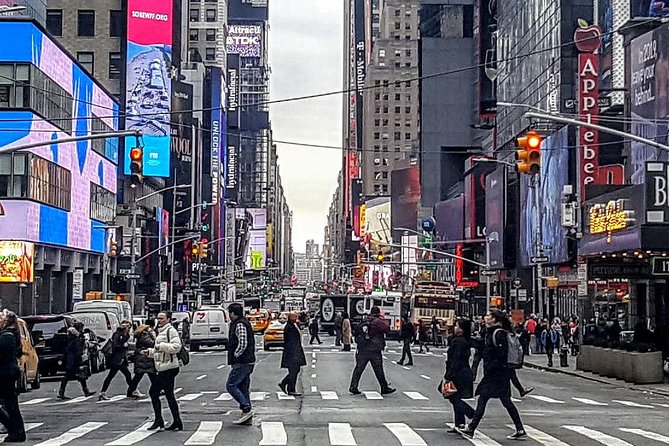
The opening stop on Eighth Avenue sets up the whole experience. Instead of beginning with a postcard view, Rob starts with the city’s shift uptown and the basic ideas behind major architectural periods. You look at everything from heavily decorated Beaux-Arts buildings to plain Modern towers.
This is also where you learn about POPS, or privately owned public spaces. These areas are provided by private property owners but open for public use, often because zoning rules offered development benefits in return. Once you understand that bargain, Midtown’s lobbies, plazas, arcades, and passageways become easier to read.
Public art by Sidney Simon and Matt Mullican helps make the point. At 350 West 50th Street, the subway station below Worldwide Plaza adds another layer, with incised granite work by Mullican and a link to changing zoning law.
The route then passes CitizenM New York Times Square, where Julian Opie’s large wall art catches the eye. Look upward too. Hearst Tower and the New York Times Building enter the skyline conversation, even though they are not the main stops.
Near the Allianz Building and Warner Music Group, you get a northward view toward Times Square. The guide uses this angle to explain how zoning helped produce a skyline with a look partly inspired by Tokyo. This is a useful reminder that New York’s famous shape was not formed by chance alone.
The Brill Building and Midtown’s culture machine

The Brill Building is a short stop, but it carries a lot of weight. It opens a discussion about how Midtown became a center for American music, theater, radio, television, publishing, advertising, newspapers, magazines, and even automobiles.
That context gives Times Square more depth. The district is not just bright signs and crowds. It has long been a place where entertainment and business meet, where culture is made, packaged, advertised, and sold.
The tour keeps moving, but it does not try to turn every stop into a long lecture. Several stops last only a few minutes. That pace helps you cover a broad section of Midtown, though people who want extended time inside every building may find the schedule brisk.
Corporate art inside 787 Seventh Avenue
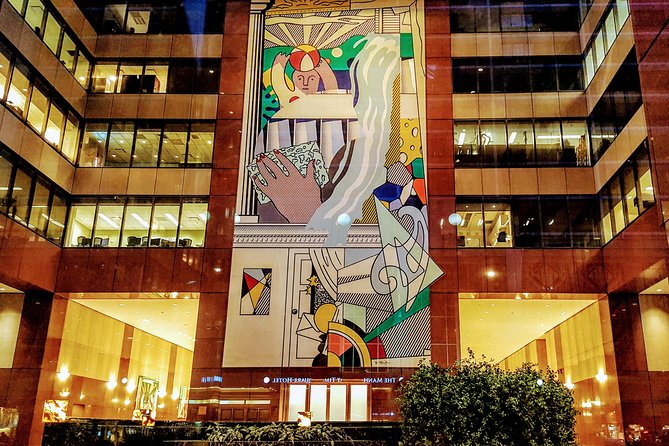
At the BNP Paribas building, the subject shifts from public entertainment to private corporate culture. The route passes the Winter Garden, the Taft Hotel, and a building linked to the song MONY MONY before entering the lobby at 787 Seventh Avenue.
Roy Lichtenstein’s Mural with Blue Brushstroke is the key work here. Lichtenstein painted it in place before the building opened, giving the lobby a direct connection to the building’s design rather than treating art as a late decoration.
Outside, the POPS includes works by Sol LeWitt and Barry Flannagan. This is one of the tour’s strongest ideas: corporate buildings can contain serious art, but you need to know where to look and understand the rules that make access possible.
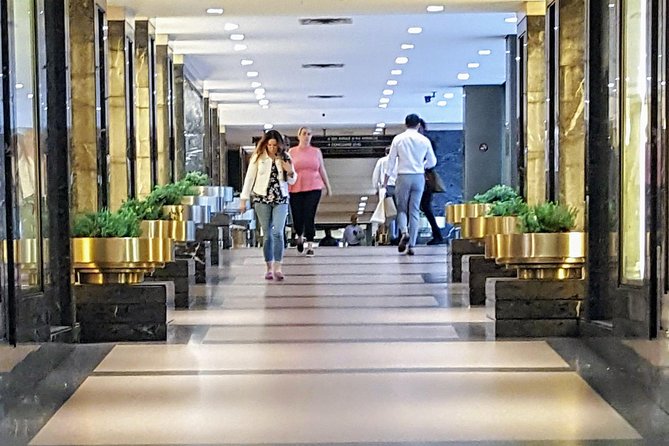
You also explore 6 1/2 Avenue, a six-block mid-block arcade that does not quite connect Times Square with Central Park. It is a small piece of urban planning with a big lesson. New York’s streets are not always as simple as the numbered avenues suggest.
More architecture walks:
- Manhattan Architecture Yacht Cruise
★ 5.0 · 1,395 reviews - NYC: Around Manhattan Official NYC Architecture Cruise
★ 4.8 · 402 reviews - Art Deco and Architecture Midtown Landmarks Tour
★ 5.0 · 142 reviews - Tribeca Architecture And History Walking Tour
★ 5.0 · 141 reviews
UBS, Time and Life, and the power of scale
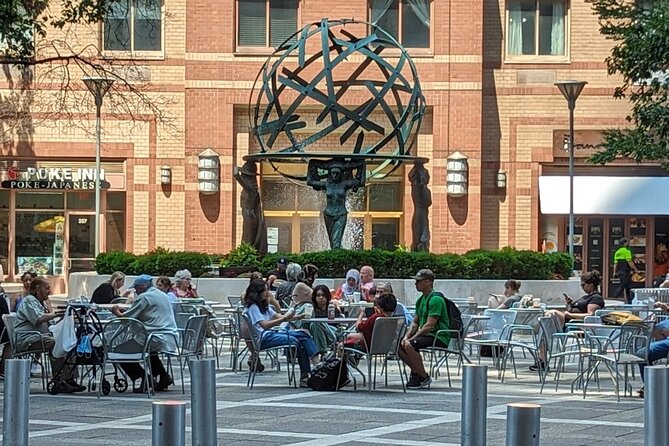
The UBS Art Gallery provides another look at corporate collections. Its lobby includes temporary and permanent displays, with artists such as Frank Stella and Sarah Morris. Access to corporate interiors can vary, but when open, these spaces add real value to the walk.
At 1271 Avenue of the Americas, the Time and Life building offers a fine example of Modern design. Stainless steel panels and a terrazzo floor create a calm contrast with the noise outside. Fritz Glarner’s wall art, shaped by his study of Mondrian, reinforces the building’s geometric character.
The works by Hiroshi Senju and Kan Yasuda continue the theme of monumental scale. Outside, La Gran Manzana adds a public artwork to the plaza. You are not simply checking off artists. You are learning how large buildings use art to shape the mood of spaces meant for thousands of office workers and passersby.
McGraw Hill, Skyscraper Alley, and Rockefeller Center
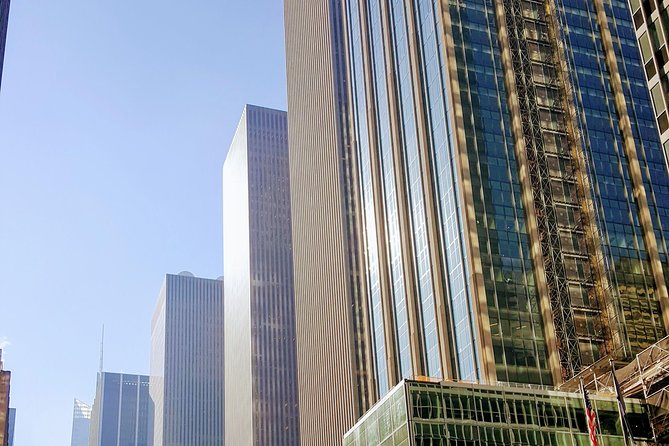
At 1221 Sixth Avenue, also known as the McGraw Hill Building, the tour includes a work by Mark Bradford. Then the group steps out beneath what the guide calls Skyscraper Alley, a chance to discuss some of Midtown’s less successful results of zoning and commercial development.
That candid note is welcome. The tour does not treat every tall building as a masterpiece. It recognizes that zoning can produce both clever public spaces and awkward towers.
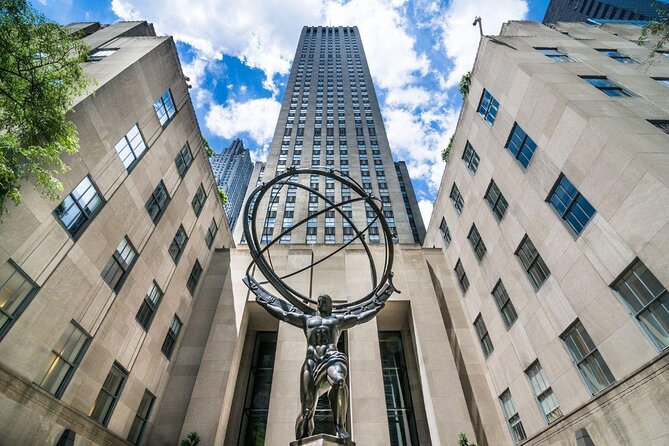
Across the avenue, the story changes at Rockefeller Center. This is the architectural and historical centerpiece of the route. You learn about the project as a major civic-minded business venture, its Art Deco style, and the way the complex shifted toward Modern design as construction continued after Raymond Hood’s death.
At Radio City Music Hall, the guide explains the origin of the name Roxy, now used for venues in many cities. The story also brings in radio, David Sarnoff, the politics of the period, and the Rockefeller family’s internal dynamics.
The rink area adds more human drama. You hear about holdouts, Diego Rivera’s conflict with the Rockefellers, the origin of the ice-skating rink, the Christmas tree, and a major reversal of fortune in the center’s history. These stories keep Rockefeller Center from becoming just another Art Deco photo stop.
Inside the International Building, the lobby itself becomes part of the lesson. Michio Lhaza’s Light and Movement provides the main wall pieces, while Lee Lawrie’s Atlas faces St. Patrick’s Cathedral outside. This pairing shows how Rockefeller Center links art, architecture, commerce, and public space.
St. Patrick’s Cathedral and Fifth Avenue’s changing face
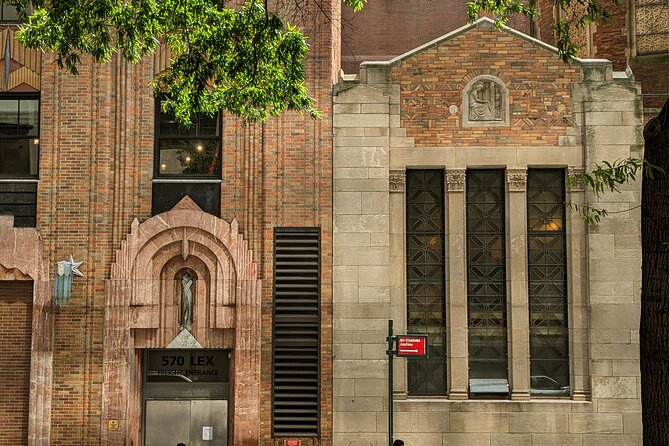
St. Patrick’s Cathedral is a brief stop, but the surrounding avenue gives the guide plenty to explain. The history of Fifth Avenue unfolds through its buildings, including the contrast between older Beaux-Arts forms and later Modern towers.
As you move toward Park Avenue, the Villard Houses appear in a striking new role. The former mansions now form part of the Palace Hotel, a useful example of how New York reuses old structures instead of leaving them frozen in the past.
This part of the route works best if you pay attention to contrasts. A grand stone residence, a polished hotel, and a glass office tower may sit close together, yet each reflects a different idea of wealth and city life.
Park Avenue from rail tracks to corporate towers
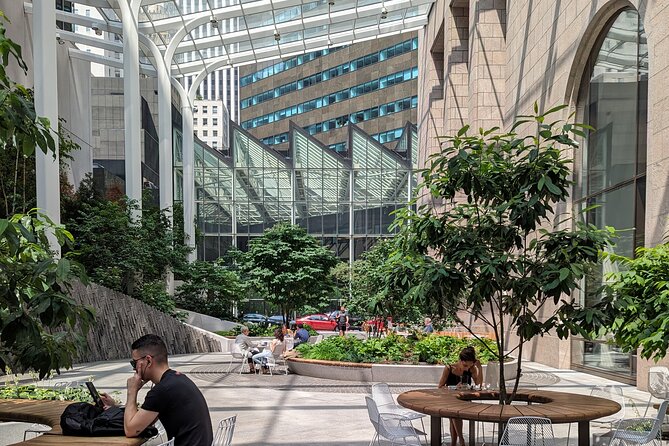
Park Avenue provides one of the clearest planning lessons on the tour. Its story begins with open train tracks, then moves through high-end residential development and finally into the corporate district known today.
Buildings discussed include the Health and Racquet Club from 1918, St. Bartholomew’s from 1919, the New York Central Building from 1929, the Waldorf Astoria from 1931, the GE Building from 1931, Lever House from 1952, the Seagram Building from 1958, and the MetLife Building from 1963.
You do not enter all of these buildings, but seeing them as part of one sequence helps you understand how the avenue changed. The dates also make the shift in style easier to follow, from historic ornament to the glass-and-steel language of corporate Modernism.
For anyone interested in architecture, planning, or real estate, this section may be the most useful part of the tour. For someone who mainly wants famous attractions, it may feel more technical. Rob’s ability to explain the buildings in plain language matters here.
Madison Avenue, sculpture, and holdout buildings
At Christie’s Sculpture Garden, 535 Madison Avenue brings together zoning, architecture, and sculpture. Works by Fernand Léger, Jean Dubuffet, and François-Xavier Lalanne represent three French artists from different periods.
The nearby Papillon Bistro & Bar provides a good example of a successful holdout in New York’s high-pressure property market. A holdout is a property owner who refuses to sell while surrounding land is assembled for a larger project. That little piece of resistance can alter an entire block.
The route may also include a Philip Johnson building with a recently redesigned outdoor POPS and Alicia Kwade’s Solid Sky, if time allows. The IBM Building’s POPS includes Applefest pieces and is regularly rated among the city’s best such spaces. These are precisely the kinds of places you are unlikely to seek out without a guide who knows how the buildings connect.
Ending beneath Billionaire’s Row
The walk ends at East 57th Street and Fifth Avenue, east of Tiffany’s, with views toward Billionaire’s Row. The final subject is the newest chapter in Midtown’s vertical growth: slender residential towers reaching extraordinary heights and carrying extraordinary prices.
This ending gives the tour a useful present-day conclusion. You begin with the city’s historic movement uptown and finish with the latest redesign of the Manhattan skyline. Along the way, you see how architectural fashion, zoning, money, transportation, and public access have shaped the center of New York.
The route is not built around entering major paid attractions. Instead, its value comes from access to spaces and stories that are free once you know where to find them. Interior access can be affected by holidays, building rules, or other closures. On one occasion, a holiday closed several underground private spaces, but Rob offered a revised route that still included less familiar locations.
Is $59 a fair price?
At $59 per person, this is a strong buy for a small-group experience. The maximum of five people gives it the feel of a private walk without the cost of booking a fully private guide.
You are paying for interpretation, not tickets. There is no admission charge at the listed stops, and the tour does not include a museum visit or a ticketed attraction. The value comes from knowing which lobbies to enter, how to read the public spaces, and how to connect a Lichtenstein mural or a subway wall to a larger city story.
The price makes the most sense for repeat New York visitors, architecture students, planners, art fans, and curious first-time visitors who want more than the standard Midtown checklist. If you only want a quick photo tour of Times Square and Rockefeller Center, you can see those places on your own for free.
Practical advice before you go
Wear comfortable shoes. The tour covers a substantial section of Midtown and operates in all weather, so dress for the forecast. A moderate fitness level is required, and the pace includes walking between many short stops.
Morning and afternoon departures let you fit the walk around other plans. The starting point is 810 Eighth Avenue, near Times Square and Hell’s Kitchen. The finish is at East 57th Street and Fifth Avenue, close to Tiffany’s and Billionaire’s Row, so you can continue sightseeing from there.
Confirmation arrives at booking, mobile tickets are accepted, and service animals are allowed. Free cancellation is available up to 24 hours before the start time. If poor weather or an insufficient number of bookings causes cancellation, you receive a choice of another date or a full refund.
Who should book this walk?
I would choose this tour if you want to understand how Midtown works rather than simply photograph it. It is especially well suited to people who enjoy architecture, public art, urban planning, American cultural history, or the odd story behind a familiar building.
The small group also helps if you like asking questions. Rob has adjusted routes, added stops, and kept an eye on walking pace and restroom breaks. His presentations draw on architectural periods, district changes, corporate art, and the history of Manhattan’s development.
You should think twice if you dislike walking in changing weather, have little interest in buildings, or want long visits inside each location. The route covers many subjects in about 2 to 3 hours, so the experience is broad and active rather than slow and museum-like.
FAQ
How long is the Midtown Manhattan Art and Architecture Walking Tour?
The tour lasts approximately 2 to 3 hours.
How many people can join the tour?
The maximum group size is five people.
What is the tour price?
The price is $59 per person.
Where does the tour begin?
The meeting point is 810 Eighth Avenue, New York, NY 10019, near the boundary of Hell’s Kitchen and Times Square.
Where does the tour end?
The tour ends at East 57th Street and Fifth Avenue, east of Tiffany’s, with views of Billionaire’s Row.
What language is the tour offered in?
The tour is offered in English.
Can the route change if indoor spaces are closed?
Yes. Some privately owned indoor spaces may be inaccessible at certain times, and the guide can offer a slightly different route. The experience may also be canceled because of poor weather or if the minimum number of bookings is not met, with another date or a full refund offered.
Should you book it?
Book this walk if you want Midtown to make more sense. For $59, you get a very small group, a route packed with public art and architectural contrasts, and a guide who can connect zoning laws, corporate power, cultural history, and New York’s changing skyline.
I would give it priority over a standard Midtown sightseeing walk if you have already seen the major landmarks or want to understand what lies between them. The best reason to go is simple: after 2 to 3 hours, you will look at a lobby, plaza, subway entrance, or tower and see the decisions behind it.
More New York City walking tours
- SoHo, Little Italy, and Chinatown Walking Tour in New York
★ 5.0 · 3,153 reviews - Secrets of Grand Central Station Walking Tour New York City
★ 5.0 · 1,796 reviews - Greenwich Village Walking and Food Tasting Tour
★ 5.0 · 1,572 reviews - Artistic, Alternative Greenwich Village Walking Tour
★ 5.0 · 971 reviews
Just listed around New York City
- NYC: Little Shop of Horrors Off-Broadway Ticket5 reviews
- Private NYC Airport Transfer: LGA to Manhattan – Up to 5★ 3.6 · 5 reviews
- New York City Tour in German★ 4.5 · 5 reviews
- New York: Hamilton and Washington Revolutionary Walking Tour★ 5.0 · 5 reviews
- NYC Freedom Tower Private Photo or Video Experience★ 4.0 · 6 reviews
- New York Afternoon Fall Foliage Cruise with Lunch★ 5.0 · 6 reviews
- Brooklyn Walking Tours by Locals: Private & 100% Personalized★ 4.0 · 6 reviews
- Southold Bay Oyster Farm Tour★ 5.0 · 6 reviews
Times Square & Midtown Tours, compared.

Circle Line “The Beast” Midtown/Downtown Speedboat Ride
Read our review →
NYC in a Day Tour: Lady Liberty, Times Square, Freedom Tower
Read our review →
Broadway and Times Square Insider Tour with Theater Professional
Read our review →
See Yourself on a Times Square Billboard for 24 Hours
Read our review →
NYC in a Day Tour: Statue of Liberty, Times Square and More
Read our review →
The Escape Game NYC: 60-Minute Adventures in Midtown Manhattan
Read our review →Browse the lists this tour appears in