Reviewed · CITY TOURS
Explore the Ruins of a Forgotten City in the Middle of Manhattan
Manhattan’s Flatiron district is more than one famous triangular building. This walk reveals a vanished city of mansions, department stores, publishers, piano dealers, saloons, hotels, and music offices, all packed into a few blocks that are easy to pass without noticing.
I like the small maximum of five people, which gives you room to ask questions and hear the guide clearly. I also like the way Rob uses historic photographs as you walk, helping you see buildings that are gone or changed beyond recognition.
The main consideration is the amount of material. This is a serious history walk, not a quick photo stop at the Flatiron Building. You will be on your feet for two to three hours, and the tour depends on decent weather.
In This Review
- Key points to know before you book
- Why this part of Manhattan rewards a closer look
- Flatiron Building and Madison Square
- Fifth Avenue and the buildings behind the facades
- Broadway and the Ladies’ Mile shopping district
- Sixth Avenue and the old department stores
- Crossing 23rd Street into the Tenderloin
- Tin Pan Alley and the business of popular music
- Hotel Wolcott and the vanished hotel belt
- The Waldorf-Astoria site and the Empire State Building
- The final blocks back toward Madison Square
- What $59 is really buying you
- Who should book this walk
- Should you book Explore the Ruins of a Forgotten City?
- FAQ
- Where does the tour begin?
- Where does the tour end?
- How long does the experience last?
- How much does the tour cost?
- How many people can join the tour?
- What language is the tour offered in?
- What landmarks will I see?
- Is the tour physically demanding?
- Is the tour suitable in poor weather?
- Can I cancel for a full refund?
Key points to know before you book
- A forgotten Manhattan appears block by block: You trace how this area changed from elite residential streets to offices, shops, hotels, entertainment venues, and commercial buildings.
- Rob leads a story-heavy walk: His approach connects architecture with money, politics, music, race, class, business, and the people who shaped the city.
- The group is limited to five people: That is especially useful when the guide is explaining details on crowded city streets.
- Historic images add another layer: You can compare today’s street corners with earlier buildings and streetscapes as you go.
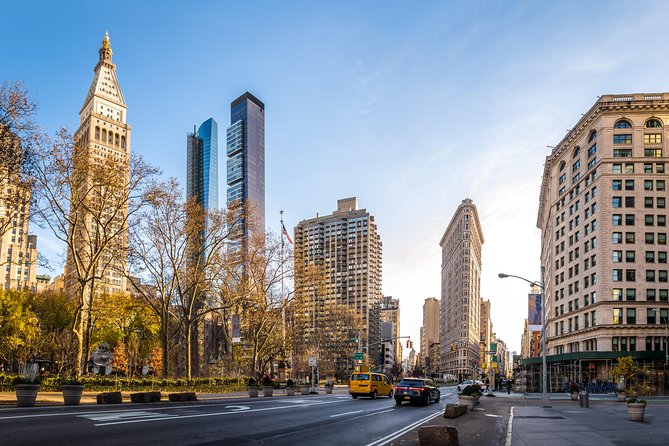
- The route covers several historic districts: Madison Square, the Ladies’ Mile area, Tin Pan Alley, the old Tenderloin, and the blocks around the Empire State Building all appear.
- The $59 price buys time and context: You are paying for a long, specialized walking tour rather than a short landmark introduction.
Why this part of Manhattan rewards a closer look
The tour begins at 175 Fifth Avenue, beside the Flatiron Building. That is a fitting starting point, since the building is both a major New York landmark and a useful lesson in how the city grew upward.
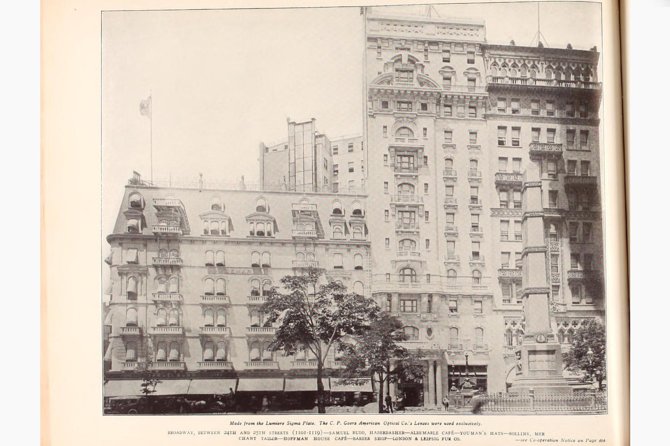
The walk focuses on the period from roughly the 1860s through the 1920s, when Madison Square became one of Manhattan’s leading social, political, and cultural centers. New fortunes from industry challenged the old power of families such as the Astors. The buildings around the park record that shift in stone, steel, glass, and changing street use.
You will not simply hear dates and names. The guide explains why buildings appeared where they did, who paid for them, who occupied them, and how one kind of business pushed another out. That cause-and-effect approach is the tour’s greatest strength.
I would choose this experience if you want to understand New York as a changing city rather than collect a few landmark photographs. If your main goal is a fast overview of Midtown, this walk may feel too detailed.
A few more New York City picks to weigh up
- New York City: Statue of Liberty & Ellis Island with Ferry
★ 4.6 · 18,683 reviews - New York City: American Museum of Natural History Ticket
★ 4.5 · 15,447 reviews - New York City: Manhattan Helicopter Tour
★ 4.7 · 7,076 reviews
Flatiron Building and Madison Square
The first stop at the Flatiron Building lasts about 15 minutes. You receive an introduction to the wider city and learn why Madison Square mattered as Manhattan’s center moved north and grew more commercial.
The Flatiron Building gives the guide a strong visual starting point. Its unusual shape makes it easy to discuss the pressures of Manhattan’s street plan, the rise of steel-frame construction, and the race to build taller commercial structures.
From there, the walk moves into Madison Square Park. About 10 minutes here sets up the social story of the Gilded Age. This was a place where older inherited wealth and newer industrial fortunes collided.
The useful point is not just that wealthy people lived nearby. The neighborhood shows how urban power changed hands. The Astors represented established social influence, while the Vanderbilts and other industrial families brought money made through new industries. Madison Square became a stage for that contest.
You may find this opening more talk than sightseeing, but it gives the rest of the walk a clear frame. Once you understand why the district became fashionable, the hotels, shops, offices, and mansions make better sense.
Fifth Avenue and the buildings behind the facades
The route follows Fifth Avenue between 23rd and 18th Streets. Here, I particularly like the attention given to the ordinary building types that helped define New York.
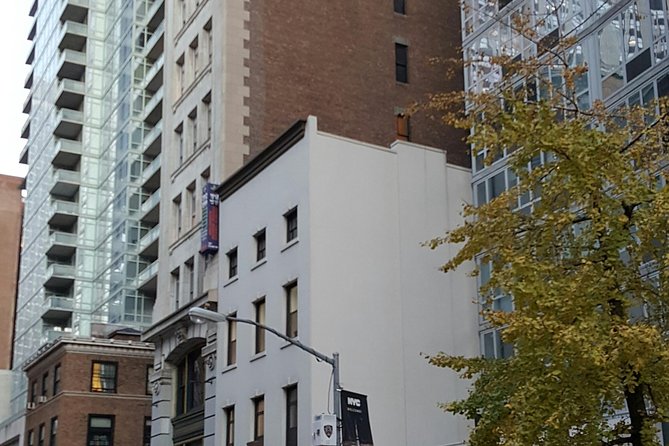
The guide examines late 19th-century steel-frame loft buildings, including long Beaux Arts designs built for manufacturing and commerce. These structures may not receive the same attention as the Flatiron Building, yet they explain how the city worked.
You learn to read the street wall. Look at the scale, windows, materials, and repeated vertical patterns. They reveal whether a building was made for homes, offices, manufacturing, retail, or a mix of uses.
This section also brings up Paternoster Row, a former business district linked to publishing and home mission offices. Publishers, architects, textile manufacturers, and piano dealers once filled streets that now feel much less central to Manhattan’s commercial life.
That contrast is one of the tour’s pleasures. The neighborhood can appear polished and familiar, but its earlier role was different. A street associated with upper-class homes became a place for offices and trade. The buildings retain clues to that change.
Broadway and the Ladies’ Mile shopping district
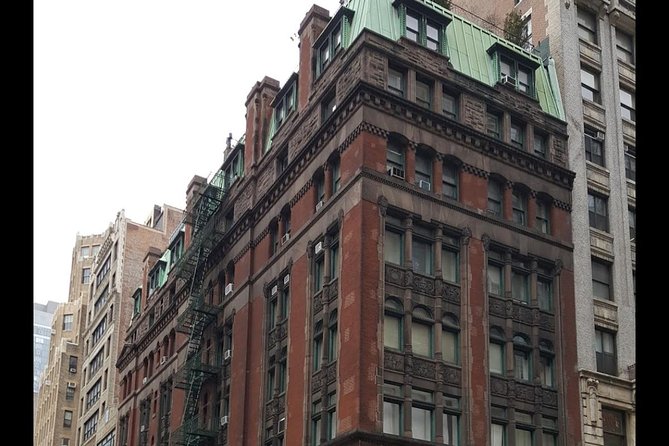
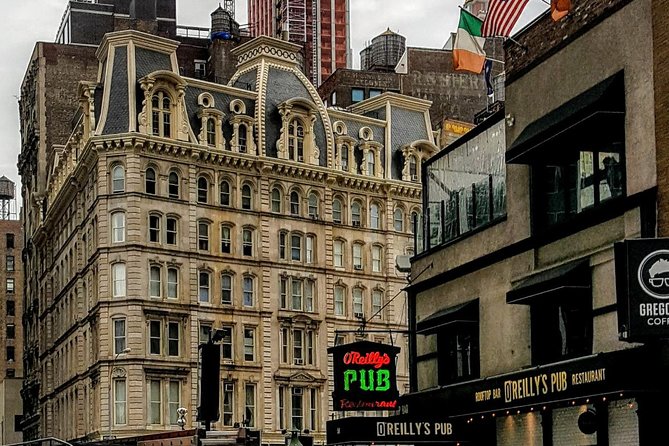
Near ABC Carpet & Home, the tour reaches Broadway between Madison and Union Square. This short stretch is described as part of the Ladies’ Mile Historic Shopping District, once a premier shopping area for well-to-do women.
The six-block section of Broadway here is unusually narrow and quiet compared with much of Manhattan. That helps you imagine an era when shoppers arrived by carriage. This particular part of Broadway did not have an elevated train or street-level horse-car rails, so women could step from carriages directly in front of the shops.
The architecture is the attraction. Fragmented French Second Empire, Beaux Arts, and Neo-Classical details survive along the street, even though the original businesses and customers are gone.
I like this stop because it connects design with social custom. The buildings were not decorated simply for beauty. Their scale and appearance helped retailers attract a particular class of customer, and the street itself was part of the shopping experience.
Do not expect a single preserved historic complex. The appeal comes from reading scattered remnants. Some facades are altered, some businesses have changed, and the old district is not presented as a frozen museum. The guide helps you spot the fragments.
The route also includes a brief stop connected to the life of a former president. The exact person is not identified in the supplied details, so you should expect this to be a small historical link within the larger walk rather than a separate presidential attraction.
Another side of New York City for the same day:
- NYC: SUMMIT One Vanderbilt Tickets
★ 4.7 · 51,195 reviews - NYC: 9/11 Memorial & Museum Timed-Entry Ticket
★ 4.8 · 31,428 reviews - NYC: Empire State Building Tickets – Observatory & Museum
★ 4.7 · 25,757 reviews - Statue of Liberty and Ellis Island Tour: All Options
★ 5.0 · 13,571 reviews
Sixth Avenue and the old department stores
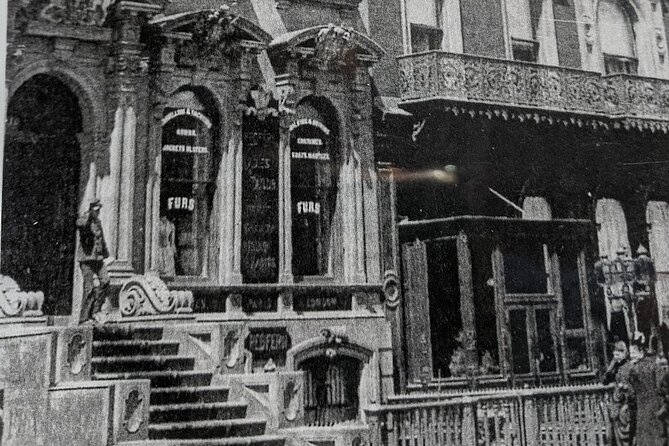
The walk then reaches Sixth Avenue, also called Avenue of the Americas, between 18th and 23rd Streets. This section contains former department stores and shopping emporia that served a broader middle-class market.
Some buildings were grand enough for carriage-trade businesses, while others catered to shoppers with less money. That difference helps explain why the area developed as more than one uniform shopping district.
The guide points out the architectural remains and discusses the department stores that once gave these blocks their energy. The stores are important not only as old buildings, but as signs of how shopping became a central part of city life.
You might not recognize every former store from the outside. That is where the historical photographs help. An image of a crowded storefront or a long-gone sign can turn an apparently ordinary block into evidence of a different city.
This is also a good place to pay attention to how commercial buildings take over residential districts. The tour repeatedly returns to this pattern: fashionable homes give way to offices, shops, hotels, and manufacturing as land becomes more valuable.
Crossing 23rd Street into the Tenderloin
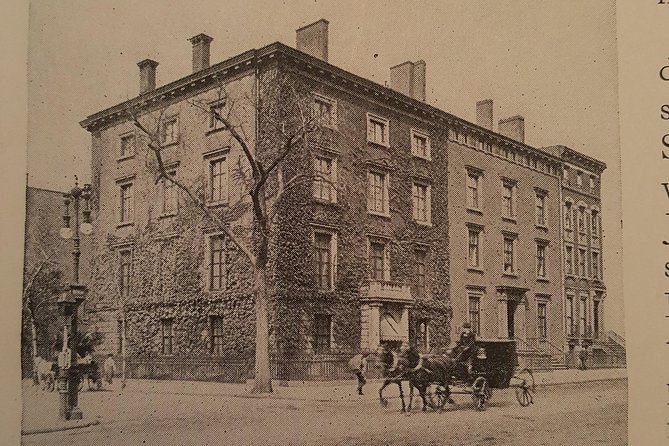
After crossing 23rd Street, the tone changes. The route enters the old Tenderloin, a district once associated with saloons, brothels, gambling halls, and other adult entertainment.
The surprising part is the location. These establishments operated close to areas associated with respectable shopping, culture, business, and civic life. The walk uses that proximity to show how sharply different parts of Manhattan could exist side by side.
Fewer historic buildings remain on this side of 23rd Street, partly because districts associated with vice were not preserved in the same way as fashionable shopping streets. What survives also reflects middle and lower-middle-class communities, including substantial African American and Jewish populations.
This portion contains some of the city’s more scandalous stories, but the value is not shock for its own sake. The old Tenderloin shows how Manhattan’s social boundaries were never as tidy as polished avenues might suggest.
Expect fewer grand facades here and more discussion of absence. A missing building can tell you something about whose past was valued, whose buildings were demolished, and how later New York preferred to remember itself.
Tin Pan Alley and the business of popular music
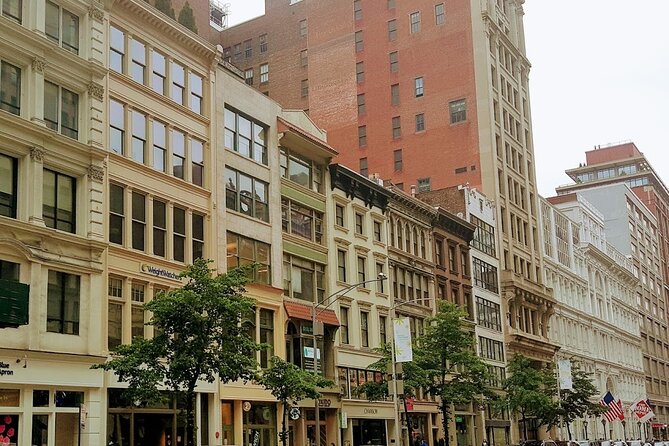
Tin Pan Alley receives a short stop of about five minutes, but it covers a subject with an outsized effect on American culture.
For a brief period, the heart of the country’s popular music business was concentrated along 28th Street between Fifth and Sixth Avenues. Sheet music publishers and song promoters worked from a few buildings, helping turn new songs into commercial products.
The guide also explains early forms of music promotion, including the many ways publishers encouraged people to perform and buy songs. This makes Tin Pan Alley more than a music-history footnote. It shows the early machinery behind mass entertainment.
Because the stop is brief, you should not expect a long musical lecture. Instead, it works as one piece of a larger explanation of how business districts changed and how New York helped create national culture.
Hotel Wolcott and the vanished hotel belt
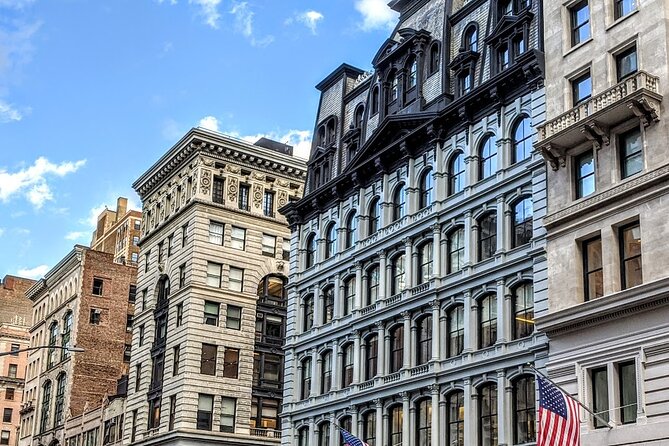
At the Hotel Wolcott, the route crosses Broadway and quickly reaches Fifth Avenue again. The shift in the street wall marks a return to the upper-class side of the neighborhood.
The Wolcott was one of more than a dozen fine Gilded Age hotels nearby. Many of those hotels have since become single-room occupancy buildings or city housing, so the district’s earlier social role is easy to miss.
This stop is a useful reminder that hotels were once a major part of Manhattan’s status system. They served wealthy visitors, long-term residents, and people who needed a fashionable address without owning a mansion.
The hotel’s present use and the surrounding changes add an important layer to the tour. New York does not preserve every neighborhood by keeping it wealthy. Buildings survive by finding new uses, and those uses can be far removed from the original purpose.
The Waldorf-Astoria site and the Empire State Building
The route continues toward the site of the original Waldorf-Astoria. Before the hotel, the area was associated with residences belonging to the Astor brothers.
The location helps connect private wealth, luxury hotels, and skyscraper development. The Empire State Building later rose nearby and held the title of world’s tallest building for 40 years.
This section captures one of Manhattan’s most dramatic changes. The city moved from grand private homes to hotels, then to immense office towers. Each step reflects higher land values, improved construction methods, and new ideas about what a city center should be.
The Empire State Building is familiar to almost everyone, but this tour places it within a much longer sequence. You see it not as an isolated icon, but as part of a neighborhood that repeatedly reinvented itself.
The final blocks back toward Madison Square
The last part of the walk covers the blocks between the Empire State Building and the Flatiron Building. These streets function like a visual guide to New York’s development, with buildings from several eras appearing close together.
That makes the ending a satisfying return to the main idea: Manhattan is built in layers. Residential streets, commercial lofts, department stores, hotels, entertainment venues, and skyscrapers replaced one another, but traces of each period remain.
The walk finishes at a convenient point in Madison Square. The exact ending spot can vary within the park, so you should not plan a tightly timed activity immediately afterward.
What $59 is really buying you
At $59 per person, this is not the cheapest way to see the Flatiron Building. You can walk past the landmark for free. The value comes from the guide’s interpretation and the amount of ground covered over two to three hours.
I would compare it with the price of a short museum visit or a basic neighborhood walk, then ask what you want from your time in New York. If you like architecture, urban development, local characters, and overlooked stories, the cost is fair for a small-group experience with a professional guide.
The group limit matters. With no more than five people, you can ask about a detail on a building or stop to study an old photograph without being lost in a crowd. Rob’s style is clearly research-heavy, and the material covers architecture, geography, business, politics, music, and social change.
This is also a good choice for repeat visitors. You may have visited Manhattan many times and still find that this route changes how you read familiar streets.
Who should book this walk
Book it if you enjoy:
- Architecture that goes beyond famous landmarks
- New York social and business history
- Historic photographs and comparisons with the present day
- Small groups and extended conversation
- Stories about music, shopping, hotels, class, and urban change
- A less tourist-focused side of Midtown and Flatiron
It suits adults, couples, solo visitors, families with older children, and local residents who want a fresh look at familiar streets. You need a moderate level of physical fitness, since the experience is a walking tour lasting up to three hours.
The tour is offered in English, includes a professional guide, and is near public transportation. Service animals are allowed. Plan for weather carefully, since poor conditions can lead to a different date or a full refund.
Should you book Explore the Ruins of a Forgotten City?
I would book this tour if you want the stories behind Manhattan’s buildings, not just the buildings themselves. Rob’s strength is connecting small architectural clues with larger changes in money, culture, politics, and everyday life.
Skip it if you want a short, highly visual landmark tour or if you dislike long explanations while walking. But if the idea of seeing a vanished city in plain sight appeals to you, the $59 fee is well spent. Reserve ahead when possible, since the experience is typically booked about two weeks in advance and the group is very small.
FAQ
Where does the tour begin?
The tour begins at the Flatiron Building, at 175 Fifth Avenue, New York, NY 10010.
Where does the tour end?
The activity ends back at the meeting point, with the final leg finishing at a convenient point in Madison Square.
How long does the experience last?
The walking tour lasts approximately two to three hours.
How much does the tour cost?
The price is $59 per person.
How many people can join the tour?
The activity has a maximum of five travelers.
What language is the tour offered in?
The tour is offered in English.
What landmarks will I see?
The route includes the Flatiron Building, Madison Square Park, Fifth Avenue, Broadway, Sixth Avenue, Tin Pan Alley, Hotel Wolcott, the site of the original Waldorf-Astoria, and the Empire State Building area.
Is the tour physically demanding?
You should have a moderate level of physical fitness, since the experience involves walking for two to three hours.
Is the tour suitable in poor weather?
The experience requires good weather. If it is canceled because of poor weather, you will be offered another date or a full refund.
Can I cancel for a full refund?
Yes. You can cancel at least 24 hours before the start time for a full refund. Cancellations or changes made less than 24 hours before the start time are not accepted for a refund.
Just listed around New York City
- NYC: Little Shop of Horrors Off-Broadway Ticket5 reviews
- Private NYC Airport Transfer: LGA to Manhattan – Up to 5★ 3.6 · 5 reviews
- New York City Tour in German★ 4.5 · 5 reviews
- New York: Hamilton and Washington Revolutionary Walking Tour★ 5.0 · 5 reviews
- NYC Freedom Tower Private Photo or Video Experience★ 4.0 · 6 reviews
- New York Afternoon Fall Foliage Cruise with Lunch★ 5.0 · 6 reviews
- Brooklyn Walking Tours by Locals: Private & 100% Personalized★ 4.0 · 6 reviews
- Southold Bay Oyster Farm Tour★ 5.0 · 6 reviews
City Tours, compared.



Top of the Rock Observation Deck New York City Ticket
Read our review →

Circle Line: 2hr – New York City Harbor Lights Cruise
Read our review →