
Reviewed · WALL STREET & FINANCIAL DISTRICT TOURS
Hamilton’s Wall Street
Hamilton’s Wall Street is really a walking lesson in how a young immigrant helped shape the United States’ financial system. You begin at the Battery, trace Hamilton’s rise from artillery captain to Washington’s right hand, then follow his mark through the streets where American finance took form.
I like the strong sense of place here. Federal Hall, Trinity Church, Wall Street, and Fraunces Tavern are not random downtown stops. Each connects to a different part of Hamilton’s military, political, personal, or financial life. I also like the guide-led storytelling, especially when Jimmy Napoli leads. He is known for speaking with energy, humor, and an astonishing store of historical detail.
The main thing to consider is pace. Jimmy’s style is fast and packed with information, which many people find exciting but can feel intense if you prefer a slow stroll. The tour is advertised at about three hours, though some related outings with Jimmy have lasted four hours, so leave room in your schedule.
In This Review
- Key points to know before you book
- Why Hamilton’s Wall Street is more than a musical tie-in
- Starting at the Battery with Hamilton the soldier
- Federal Hall and the birth of national power
- Trinity Church, the Hamilton family, and a quieter pause
- Wall Street and the financial system Hamilton imagined
- Fraunces Tavern, Hamilton’s old haunt
- Jimmy Napoli’s fast, funny teaching style
- Price, group size, and what you receive
- Who should take this lower Manhattan walk?
- Should you book Hamilton’s Wall Street?
- FAQ
- Where does Hamilton’s Wall Street begin?
- What time does the tour start?
- Where does the tour end?
- How long is Hamilton’s Wall Street?
- How far do you walk?
- What places does the tour visit?
- Is admission included at the stops?
- How many people can join the tour?
- Can I cancel for a full refund?
Key points to know before you book

- Hamilton’s financial vision is the central theme: This is more than a tour of movie locations or musical references. It explains how Hamilton helped build the systems behind American national credit and banking.
- The route covers about 1.5 miles: You walk from the South Ferry Terminal to Wall Street, with several stops in lower Manhattan.
- Jimmy Napoli is the guide most closely associated with the experience: His style is quick, funny, highly detailed, and open to questions.
- The Battery gives the story a military beginning: The tour places Hamilton’s early service against the American Revolution and New York’s wartime role.
- Trinity Church and Fraunces Tavern add personal texture: You see the Hamilton family graves and stop at one of Hamilton’s old haunts for a drink.
- The group can include up to 25 people: That is small enough for a guided walk, though not the same as a private tour.
Why Hamilton’s Wall Street is more than a musical tie-in
If your interest in Alexander Hamilton began with the Broadway musical, this walk gives you a larger picture. The show highlights his ambition, writing, political fights, friendships, and fatal feud. This tour focuses especially on what happened after the Revolution, when the new nation needed a working financial system.
Hamilton helped create the Bank of New York in 1784 and the First National Bank in 1790. The tour presents these moves as part of his effort to restore national credit after the country’s finances had fallen into serious trouble.
That focus makes the experience useful even if you are not a devoted Hamilton fan. You get a clearer sense of how lower Manhattan connected military service, government, banking, and commerce. Wall Street becomes more than a famous name. It becomes a place where ideas about the new nation took practical form.
I would not book this as a general sightseeing walk through lower Manhattan. The route is designed around one historical figure and his influence. You will get the most from it if you enjoy American history, the founding period, political argument, or the way cities preserve old stories beneath modern buildings.
More Wall Street walks:
- NYC City Tour: Statue of Liberty, 9/11 Memorial, Wall Street
★ 4.5 · 2,059 reviews - Wall Street Insider Tour with a Finance Professional
★ 4.5 · 660 reviews - Wall Street Insider Tour with a Finance Professional
★ 4.5 · 571 reviews
Starting at the Battery with Hamilton the soldier
The meeting point is the South Ferry Terminal, near the Battery at the southern end of Manhattan. The tour begins at 11:00 a.m. and uses the Battery to recall the American Revolution and the price New York paid during the war.
This is a smart opening. Hamilton’s later work as a statesman and financial planner can make him seem like a man who appeared fully formed in a government office. The Battery setting puts the military chapter first. You hear how he rose from captain of an artillery company to become one of George Washington’s closest aides.
The exact stops and speaking time can vary, but the purpose is clear: connect Hamilton’s drive to the pressures of wartime New York. That gives his later achievements a human scale. He was not only designing banks and arguing over national policy. He was also a young officer trying to advance in a dangerous and uncertain conflict.
The Battery is also a practical place to begin because the walking route is limited to about a mile and a half. You are not signing up for an exhausting cross-town march. Still, wear comfortable shoes. The experience is almost entirely about moving through the streets and pausing for talks.
Federal Hall and the birth of national power
Federal Hall is the next major stop. Admission is listed as free, and the group has a 15-minute stop with a bathroom break.
Federal Hall matters because it brings the discussion from the battlefield to the new government. The building and its surroundings are tied to the early federal period, making it a fitting place to discuss Hamilton’s work on national finance and the structure of the new country.
Do not expect a long museum visit based on the published timing. Fifteen minutes is enough for an explanation and a quick pause, not a full examination of every exhibit or room. The bathroom break is useful, particularly for families and anyone who has just arrived from the subway or ferry.
I like this stop because it helps you connect Hamilton’s financial plans to government itself. Banking was not treated as a separate modern industry. It was part of the urgent work of making the United States function as a nation.
The guide’s presentation is important here. Jimmy Napoli’s reputation is built on a lively lecture style, with quick delivery, jokes, and many small details. If you enjoy a speaker who keeps the pace moving, Federal Hall should be one of the stronger sections. If you need time to take notes or process each point, stand close enough to hear clearly and ask the guide to slow down when needed.
Trinity Church, the Hamilton family, and a quieter pause
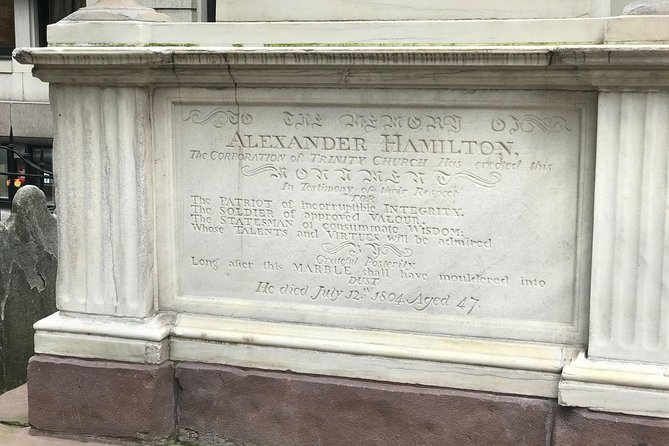
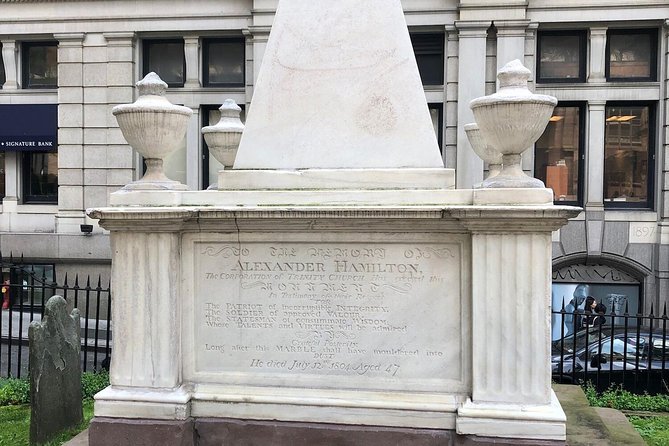
The tour then visits Trinity Church Wall Street and its graveyard. The listed stop lasts about 10 minutes and is free.
This is the most personal point on the route. The churchyard is the final resting place of the Hamiltons, and the visit gives you a chance to pay respect rather than simply hear another political anecdote. After the broad subjects of war, banking, and national credit, the graves make Hamilton’s story more intimate.
The stop is brief, so expect a focused visit. You may have time to see the family’s resting place and hear why Trinity is important to the Hamilton story, but you should not plan on a long church tour from the information provided.
I find this kind of pause valuable because it keeps the experience from turning into a list of institutions. Hamilton’s public work was immense, but his life also had a family setting and a final resting place. The churchyard gives the story a quieter rhythm before the route returns to the forceful public image of Wall Street.
Please treat this as a place of respect. The tour description specifically frames the visit as a tribute to the Hamilton family. That tone matters, especially in a busy part of New York where it is easy to rush from one stop to the next.
More Broadway seats to book:
- NYC: Aladdin the Musical on Broadway
★ 4.8 · 1,800 reviews - NYC: The Lion King on Broadway
1,609 reviews - NYC: MJ the Musical on Broadway
1,510 reviews - NYC: Moulin Rouge! the Musical on Broadway
1,329 reviews
Wall Street and the financial system Hamilton imagined
Wall Street is the tour’s central setting. The stop is listed at about 10 minutes, but the larger story of Wall Street runs through much of the walk.
The street itself is short and narrow, yet its name has become a global symbol of commerce and finance. That contrast is part of the fun. You are standing in a compact downtown corridor while discussing financial power that reaches far beyond New York.
The tour presents Hamilton as the Founding Father who most clearly imagined the United States as a modern financial nation. His role in creating the Bank of New York and the First National Bank, along with his work to restore national credit, forms the heart of this section.
This is where the experience can change your view of lower Manhattan. Instead of seeing only office towers and crowded sidewalks, you begin to read the area as the setting for arguments over debt, credit, banks, federal authority, and the role of commerce in the new republic.
The stop itself is short, so much of the value comes from the guide’s explanation rather than from a long building visit. You will not be spending hours inside a financial museum. You are using the street as a stage for a fast-moving account of Hamilton’s ideas and ambitions.
One practical note: Wall Street can be loud and crowded. Jimmy Napoli is known for speaking quickly, and city noise may make it harder to catch every word. Stay near the guide and keep questions for natural pauses. This is not a bad feature of the tour, but it is part of taking a history lecture outdoors in lower Manhattan.
Fraunces Tavern, Hamilton’s old haunt
The final listed stop is Fraunces Tavern Museum. The group spends about 15 minutes there and stops for a drink at one of Hamilton’s old haunts.
Fraunces Tavern adds a social setting to the story. Federal Hall represents government, Wall Street represents finance, Trinity Church represents family and remembrance, and Fraunces Tavern recalls the world of conversation and gathering around Hamilton’s public life.
The phrase stop for a drink deserves a practical reading. The tour description says the group visits Fraunces Tavern for a drink, but it does not specify whether that drink is included in the $90.43 price. I would be prepared to pay separately unless your booking details say otherwise.
The museum stop is also brief. Think of it as a focused visit and a chance to mark the end of the walk, not a full museum afternoon. The final destination is listed as 60 Wall Street, and the experience ends in the Wall Street area.
I like this finish because it gives the tour a human, celebratory note. Hamilton can seem relentless and abstract when the discussion stays on credit and national policy. A tavern linked to his life brings the story back to the people and places around him.
Jimmy Napoli’s fast, funny teaching style
The guide can make or break a history walk, and Jimmy Napoli is a major part of this one. His approach is not a quiet audio-guide stroll. He delivers a large amount of material with speed, enthusiasm, humor, and frequent asides.
His storytelling covers Hamilton’s life, the other Founding Fathers, the Revolution, the federal treasury, and the political deals that shaped the early nation. He also welcomes questions and back-and-forth discussion. That matters if you want to explore a point rather than simply listen from start to finish.
Children and teenagers may do well with this style if they already have some interest in Hamilton. The experience has held the attention of children as young as 10 and 11 on related walks, and younger people have enjoyed the jokes and dramatic storytelling. Still, I would not call it a light family sightseeing tour. The content is detailed, and the pace may be demanding for a child who has no interest in the subject.
The guide’s speed is worth taking seriously. People who enjoy a walking lecture will likely appreciate the energy. People who want long pauses for photographs or quiet reflection may prefer a less packed format.
Guides can vary, and some outings connected with the provider have been led by Eve and Asja. The strongest guide-specific information points to Jimmy Napoli, so I would check the booking details if having him matters to you.
Price, group size, and what you receive
The price is $90.43 per person for about three hours. That is not a cheap casual walk, so the value depends on what you want from a tour.
You are paying mainly for the guide’s time, research, interpretation, and storytelling. The stops themselves are mostly free, and the route does not center on costly admissions. If you already know Hamilton’s story well and prefer to read plaques at your own pace, the price may feel high.
I see better value if you want the connections made for you. The guide links military service to political power, political power to financial planning, and financial planning to the modern meaning of Wall Street. That kind of structure is hard to get from wandering alone.
The group size can reach 25 people. That is manageable for a city walk, though the experience will feel more personal with a smaller group. A very small group may allow more questions and easier conversation. With a full group, stay near the front and make sure you can hear the guide at outdoor stops.
A mobile ticket keeps the entry simple. The tour is near public transportation, begins at South Ferry Terminal, and ends at 60 Wall Street. Most people can participate, and service animals are allowed. The route is limited to about 1.5 miles, but you will be on your feet for much of the three-hour period.
Free cancellation is available if you cancel at least 24 hours before the local start time. Changes or cancellations inside that window are not accepted for a refund. The experience also requires a minimum number of participants, so a provider cancellation for that reason brings either another date or a full refund.
Who should take this lower Manhattan walk?
I would choose this tour if you fit one or more of these descriptions:
- You loved the Hamilton musical and want the real places and political context behind it.
- You enjoy the American founding period and want more than a quick monument visit.
- You like energetic guides who talk often, move quickly, and connect many details.
- You are visiting lower Manhattan and want a focused historical route rather than a general city tour.
- You are traveling with a child or teenager who already has a strong interest in Hamilton.
I would hesitate if you want a relaxed, photo-heavy walk with long indoor visits. The published stops are short, the tour is information-heavy, and the guide’s delivery may be fast. It is also less useful if your main goal is modern Wall Street or a detailed look inside financial institutions.
Should you book Hamilton’s Wall Street?
Book it if you want Alexander Hamilton’s life tied to real streets, churches, government buildings, and gathering places. The best part is not any single stop. It is the way the walk explains how Hamilton moved from wartime service to national finance, and how lower Manhattan helped shape that story.
At $90.43, this is a specialist tour, not a bargain general introduction to New York. I would reserve it for a history-minded day, wear good shoes, stay close to the guide, and allow extra time in case the talk runs longer than the advertised three hours.
If Jimmy Napoli is leading, expect a lively and very full presentation, with jokes, rapid delivery, and plenty of detail. If that sounds like your kind of history, Hamilton’s Wall Street is a strong choice. If you prefer quiet sightseeing, choose a slower walking tour instead.
FAQ
Where does Hamilton’s Wall Street begin?
The tour begins at South Ferry Terminal in New York City, near the Battery.
What time does the tour start?
The scheduled start time is 11:00 a.m.
Where does the tour end?
The tour ends at 60 Wall Street, New York, NY 10005.
How long is Hamilton’s Wall Street?
The advertised duration is approximately three hours. Some related outings with the guide have lasted longer, so allowing extra time is sensible.
How far do you walk?
Walking is limited to about 1.5 miles.
What places does the tour visit?
The route includes the Battery, Federal Hall, Trinity Church Wall Street and its graveyard, Wall Street, and Fraunces Tavern Museum.
Is admission included at the stops?
The listed admission tickets for Federal Hall, Trinity Church Wall Street, Wall Street, and Fraunces Tavern are free. The tour description does not state whether a drink at Fraunces Tavern is included in the tour price.
How many people can join the tour?
The activity allows a maximum of 25 participants.
Can I cancel for a full refund?
Yes. You can cancel at least 24 hours before the experience start time for a full refund. Cancellations or changes made less than 24 hours in advance are not accepted for a refund.
Just listed around New York City
- NYC: Little Shop of Horrors Off-Broadway Ticket5 reviews
- New York City Tour in German★ 4.5 · 5 reviews
- Private NYC Airport Transfer: LGA to Manhattan – Up to 5★ 3.6 · 5 reviews
- New York: Hamilton and Washington Revolutionary Walking Tour★ 5.0 · 5 reviews
- NYC Freedom Tower Private Photo or Video Experience★ 4.0 · 6 reviews
- New York Afternoon Fall Foliage Cruise with Lunch★ 5.0 · 6 reviews
- Brooklyn Walking Tours by Locals: Private & 100% Personalized★ 4.0 · 6 reviews
- Southold Bay Oyster Farm Tour★ 5.0 · 6 reviews
Wall Street & Financial District Tours, compared.

NYC City Tour: Statue of Liberty, 9/11 Memorial, Wall Street
Read our review →
Wall Street Insider Tour with a Finance Professional
Read our review →Wall Street Insider Tour with a Finance Professional
Read our review →
Manhattan Group Tour Including Wall Street and 911 Memorial
Read our review →
Wall Street Tour with 9/11 Memorial and Statue Ferry
Read our review →
Wall Street and Financial District Walking Tour
Read our review →

Wall Street and Financial District Walking Tour
Read our review →Browse the lists this tour appears in