
Reviewed · NEW YORK CITY
Lower Manhattan: From Financial Power to Enduring Hope
Lower Manhattan packs several centuries into a few compact blocks. On this walk, Jon Noto connects Wall Street, old Dutch New Amsterdam, American independence, Hollywood film sites, and the painful history of September 11 without treating them as separate museum exhibits. The result is a useful first look at the city’s oldest core.
I like two things here. First, the route makes familiar sights such as the Charging Bull and Wall Street feel less like photo stops and more like pieces of a long story. Second, Jon’s approach combines careful facts with human stories, humor, and practical New York advice. The main consideration is the pace: with 12 stops in about two and a half hours, you will cover a lot of ground, but some locations receive only five minutes.
In This Review
- Key points to know before you book
- Why this small part of New York matters
- From the Charging Bull to Bowling Green
- The former Custom House and American history
- Fraunces Tavern and the memory of New Amsterdam
- Stone Street, where old buildings still shape the walk
- Hanover Square and a quieter September 11 memorial
- Delmonico’s and the Wall Street movie connection
- Wall Street, the 1920 bombing, and the old Dutch wall
- The House of Morgan and a cinematic Gotham
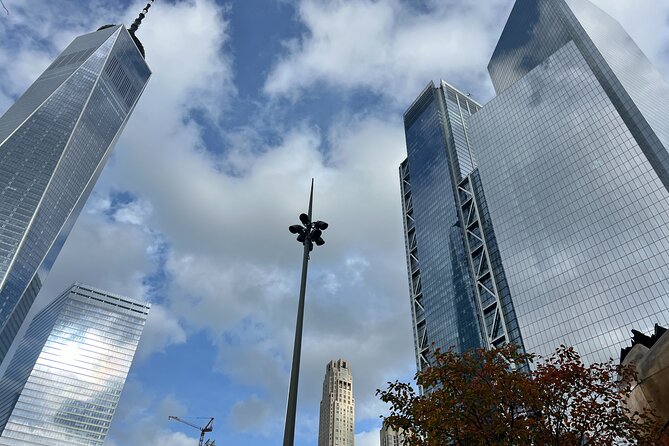
- Ending at the Oculus and World Trade Center
- How Jon Noto shapes the experience
- Price, group size, and practical value
- Who should book this Lower Manhattan walk?
- Should you book it?
- FAQ
- How long does the tour last?
- What time does the tour begin?
- Where does the tour begin?
- Where does the tour end?
- Is admission to the attractions included?
- Is the tour offered in English?
- Is coffee or tea included?
- How large can the group be?
- Is the tour suitable for anyone with limited mobility?
- Can I cancel for a full refund?
Key points to know before you book
- Start at the Charging Bull: Meet at Bowling Green at 10:00 am, beside one of New York’s most photographed symbols.
- See Lower Manhattan in layers: The route moves from Dutch New Amsterdam and colonial New York to modern finance and 9/11.
- Jon Noto leads the walk: His storytelling covers history, architecture, movies, local details, and the September 11 attacks.
- Expect a compact but busy route: Most stops last five minutes, with one ten-minute stop at the old Wall Street area.
- Finish at the Oculus: The walk ends outside or inside the World Trade Center transportation hub.
- Plan for city walking: The tour lasts about two and a half hours and calls for a moderate fitness level.
Why this small part of New York matters
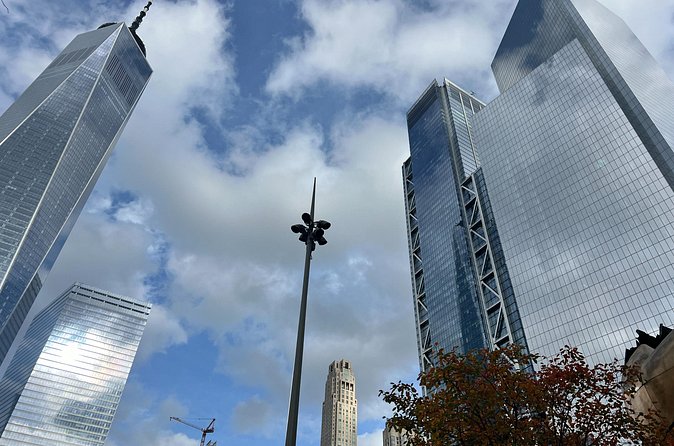
Lower Manhattan is where New York’s big stories sit unusually close together. A few steps can take you from the Dutch settlement of New Amsterdam to the center of global finance. A grand old building may have been a customs house, a bank, a film set, or a witness to political change.
That compression is the real value of this tour. You are not simply looking at buildings. You are learning how the city changed hands, made money, absorbed immigrants, shaped American politics, and rebuilt after tragedy.
The title, From Financial Power to Enduring Hope, points toward the route’s emotional arc. The walk begins with symbols of wealth and power, then moves through older layers of New York before ending at the World Trade Center. The September 11 material is not a minor footnote. Jon is especially focused on that history, and the walk includes a memorial connection involving British people who died in the attacks.
Big New York City bookings that pair well with this one:
- NYC: SUMMIT One Vanderbilt Tickets
★ 4.7 · 51,195 reviews - NYC: 9/11 Memorial & Museum Timed-Entry Ticket
★ 4.8 · 31,428 reviews - NYC: Empire State Building Tickets – Observatory & Museum
★ 4.7 · 25,757 reviews
From the Charging Bull to Bowling Green
The tour begins at the Charging Bull near Bowling Green. The bull is a modern symbol of financial confidence, and it gives Jon an easy starting point for explaining the character of Wall Street.
You will also spend a little time in Bowling Green, New York City’s oldest park. Its old fence is part of the appeal. This is a good reminder that Lower Manhattan is not just a district of glass towers and stock-market headlines. It is also a place where the city’s early public spaces survive amid intense development.
The opening stops are brief, just five minutes each. That works well for orientation and photographs, but do not expect a long lecture beside the bull. The guide’s larger story continues as the group walks.
The former Custom House and American history
The route next passes the National Museum of the American Indian, housed in the former US Custom House. The building itself helps explain how New York became a major port and trading center. At the front, you will see any visible statue by Samuel Chester French on display outside.
This is a short stop, so the value depends on Jon’s explanation of what you are seeing. I would treat it as an architectural and historical marker rather than a museum visit. Admission to the museum is not part of the walk, and the tour does not allow time for an interior visit.
That distinction matters if you are planning your day. You can use the walk to decide if you want to return later for the museum, but do not book this experience expecting a guided museum tour.
Fraunces Tavern and the memory of New Amsterdam
Fraunces Tavern brings the story closer to the American Revolution. The site is linked to one of New York’s oldest taverns and to George Washington, who frequented the location. Even a quick look helps you picture a city before the modern financial district took shape.
The next stop, a remnant of Lovelace Tavern, reaches further back to Dutch New Amsterdam. A small surviving fragment can be more useful than a grand monument because it shows how much of early New York has disappeared. The city was rebuilt again and again, often leaving only odd pieces behind.
These stops reward curiosity. You may not see a large collection or spend long inside a historic room. Instead, Jon uses the street itself as the setting and explains how colonial New York developed around trade, taverns, ports, and political power.
Another side of New York City for the same day:
- New York City: Statue of Liberty & Ellis Island with Ferry
★ 4.6 · 18,683 reviews - New York City: American Museum of Natural History Ticket
★ 4.5 · 15,447 reviews - Statue of Liberty and Ellis Island Tour: All Options
★ 5.0 · 13,571 reviews - New York in One Day Guided Sightseeing Tour
★ 5.0 · 13,166 reviews
Stone Street, where old buildings still shape the walk
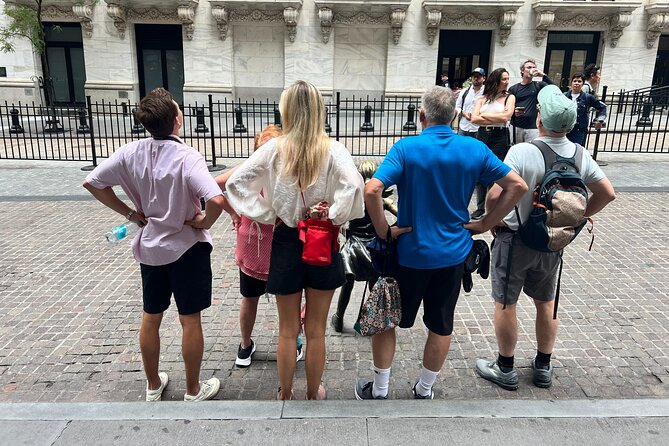
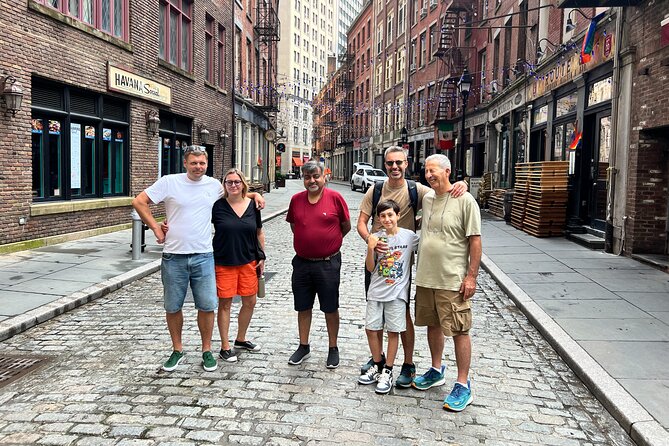
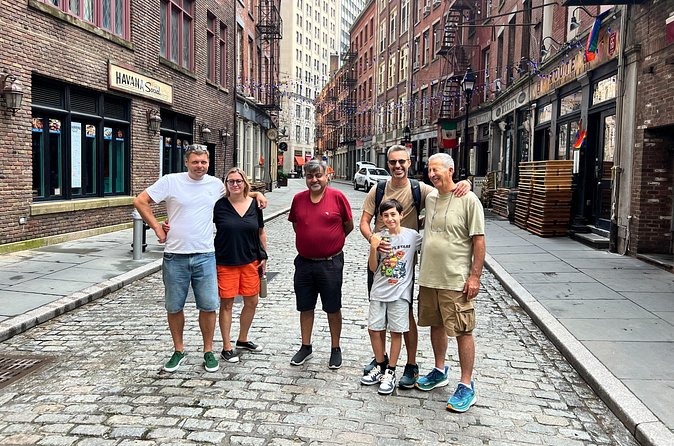
Stone Street is one of the most atmospheric parts of the route. Its historic buildings give you a clearer sense of old Lower Manhattan than the broad financial avenues do. The contrast is sharp: narrow lanes and old facades sit close to towers built for modern commerce.
This is a spot where I would slow down mentally, even if the group keeps moving. Look up at the buildings, note the scale of the street, and listen for the connection between the old city and the present one.
The itinerary allows about five minutes here. That is enough for a guide-led introduction, but not a long architectural study or a meal. Stone Street has restaurants and bars, yet food and drinks are not included in the $39 price.
Hanover Square and a quieter September 11 memorial
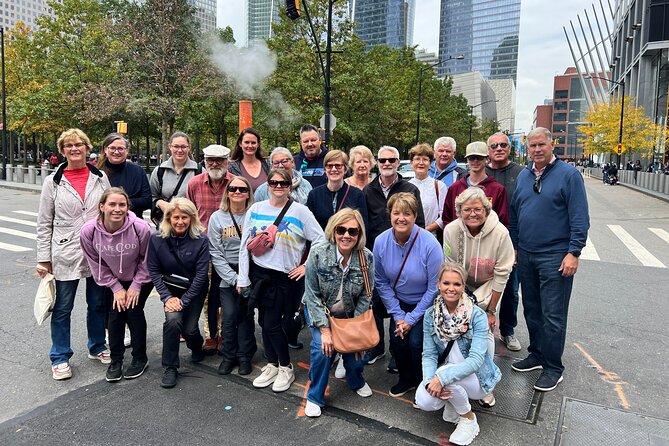
At Hanover Square, the tour pauses in the Queen Elizabeth II Garden. The garden includes a memorial to British people who died on September 11. It is a quieter place to consider the international reach of the attacks, away from the larger crowds around the main World Trade Center memorial.
This portion of the walk shifts the tone. Jon’s storytelling about September 11 is one of the strongest reasons to choose this tour if you want more than a quick visit to the memorial pools. He brings attention to the human cost and the wider New York context, rather than treating the subject as a list of dates and buildings.
The subject is serious, and the tour’s title signals that the walk does not end with financial power. It moves toward memory and endurance. If you prefer a tour focused only on architecture or Wall Street trivia, this emotional turn may feel heavier than expected.
Delmonico’s and the Wall Street movie connection
Delmonico’s adds a lighter, more modern layer. The building has its own long story, but it is also recognizable to film fans because it was used as an interior location for the John Wick films.
That connection gives the walk a useful change of pace. You can look at the same building in two ways: as part of New York’s restaurant and business history, and as a fictional place in a major action series. Jon also points out the Wall Street Court area, including the New York Cocoa Exchange and another interior location associated with the Continental Hotel in John Wick.
These movie references are not the main reason to book the tour, but they make the history easier to remember. They also appeal to anyone who enjoys seeing how familiar screen locations fit into real city streets. The tour does not promise film props, interior access, or a dedicated movie tour. The pleasure comes from identifying the buildings from outside.
Wall Street, the 1920 bombing, and the old Dutch wall
The route returns to Wall Street for some of its most important context. You will see a building that briefly became the world’s tallest and later was purchased by Donald Trump in the 1990s. The stop shows how buildings in this district can pass from one form of power to another, from banking and commerce to modern real estate fame.
Another Wall Street stop covers the site of the 1920 bombing. You will also hear about remnants of the Dutch wall that gave Wall Street its name. These details widen the usual Wall Street story. The street is not only about stock exchanges and wealthy financiers. It also reflects violence, defense, urban expansion, and the city’s changing identity.
The final Wall Street stop lasts about ten minutes, which is useful because the material needs more context. Still, you should expect an outdoor walking explanation, not access to private offices or a formal building tour.
The House of Morgan and a cinematic Gotham
The House of Morgan is the last major historical stop. This was JP Morgan’s first bank, and the building also appeared as the Gotham Stock Exchange in The Dark Knight Rises.
Jon explains why Morgan made the building so tiny, a detail that turns architecture into personality and business strategy. This kind of small question is exactly what can make a walking tour worthwhile. A building’s size, placement, and appearance can reveal how a powerful person wanted to work and be seen.
By this point, the route has moved through Dutch settlement, colonial society, revolution, finance, terrorism, memorial culture, and cinema. The House of Morgan ties several threads together: money, reputation, architecture, and the way New York becomes a stage for fictional cities.
Ending at the Oculus and World Trade Center
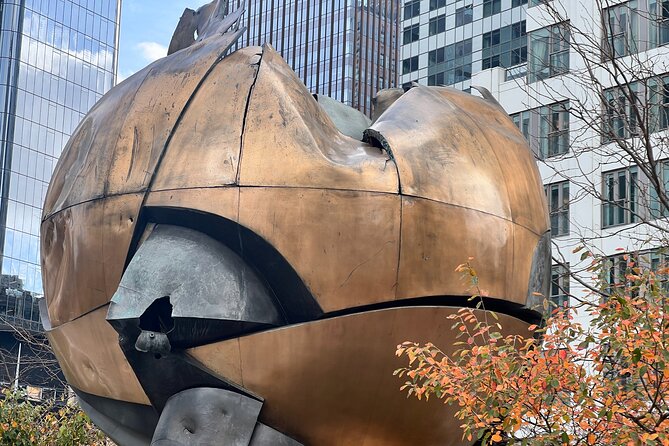
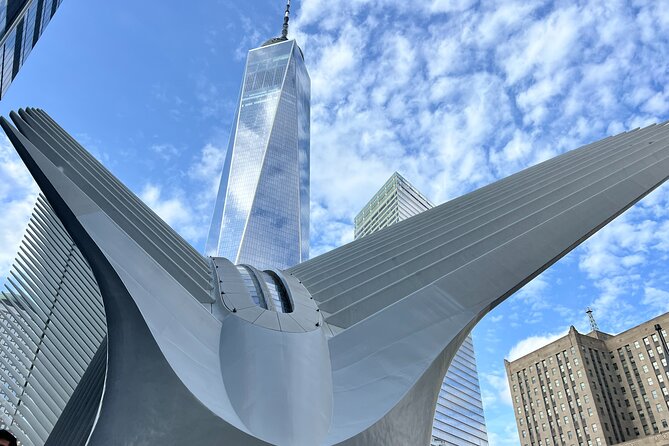
The walk finishes at the Oculus, the striking World Trade Center transportation hub at 185 Greenwich Street. The group may end just outside or inside the building, so allow a little flexibility when arranging your next activity.
The ending is practical as well as symbolic. You are near major public transportation, and the Oculus gives you a clear place to continue toward the 9/11 Memorial, museums, shopping, or other parts of Lower Manhattan. The tour itself is not a substitute for visiting the memorial or museum, but it can give you context before you go.
I like this ending because it links the historic street grid to the rebuilt World Trade Center. You finish not with a single conclusion, but with a sense of how the district keeps changing.
How Jon Noto shapes the experience
Jon Noto is the named guide associated with this walk. His style, based on the tour details and direct experience described by participants, is story-first and highly interactive. He covers a great deal of material without turning the walk into a dry lecture, and he welcomes questions.
His strongest subjects appear to be New York history and September 11. He also adds food suggestions and neighborhood advice when asked. That can be handy if this is early in your trip, since you may leave with ideas for restaurants or plans in other parts of the city.
The tone is not solemn all the way through. Humor, film references, curious facts, and local tips break up the heavier sections. Jon has also adjusted the route in poor weather, adding indoor elements and coffee opportunities when possible. Coffee or tea is not included, and any purchase is your responsibility, but a break may be possible depending on the route and conditions.
Price, group size, and practical value
At $39 per person, this is a fair price for a two-and-a-half-hour guided walk in one of the world’s most expensive cities. You are paying for a licensed professional guide, not entry to attractions. Since every listed stop is viewed from public space, the value rests almost entirely on Jon’s research, explanations, pacing, and ability to connect the pieces.
The group can include up to 25 people. That is small enough to feel more personal than a large coach tour, though it is not a private walk. If you want to ask many questions, stay near the guide and speak up when the group pauses.
Wear comfortable shoes and prepare for steady city walking. A moderate level of fitness is recommended. The experience is offered in English, uses a mobile ticket, and begins at 10:00 am. It is near public transportation at both ends, which makes it easy to fit into a full New York day.
The cancellation terms are simple: you can receive a full refund if you cancel at least 24 hours before the start time. Cancellations or changes made inside that window are not refunded or accepted.
Who should book this Lower Manhattan walk?
I would choose this tour if you want a single route that explains the district instead of merely naming its landmarks. It suits first-time visitors, history fans, architecture followers, film enthusiasts, and anyone who wants a thoughtful introduction to Wall Street and the World Trade Center area.
It is also a good pick if you have only one guided walk available during a short New York visit. The range is unusually broad, and Jon’s local recommendations may help with the rest of your itinerary.
I would hesitate only if you want long visits at each stop, museum admission, a food tasting, or a private group. The five-minute stops keep the route moving, but they limit time for photographs and quiet exploration. The September 11 discussion also deserves your full attention and may not suit anyone seeking a light, purely entertaining outing.
Should you book it?
Book it if you want Lower Manhattan to make sense as a connected story. For $39, the tour offers strong value through context, not admissions, and the route ends in a useful place for continuing your day.
Choose another experience if you prefer to explore independently, spend an hour inside one museum, or focus only on finance. For most visitors who want a clear, human introduction to New York’s oldest streets, this is a smart use of two and a half hours.
FAQ
How long does the tour last?
The tour lasts approximately two hours and 30 minutes.
What time does the tour begin?
The scheduled start time is 10:00 am.
Where does the tour begin?
The tour begins at the Charging Bull near Bowling Green, New York, NY 10004.
Where does the tour end?
It ends at the Oculus World Trade Center at 185 Greenwich Street. The guide may finish either just outside or inside the Oculus.
Is admission to the attractions included?
The listed stops have no admission charge, and the experience includes a licensed professional guide. Museum entry and other paid admissions are not included.
Is the tour offered in English?
Yes. The tour is offered in English.
Is coffee or tea included?
No. There may be an opportunity for a coffee break depending on the guide’s route, but you must buy coffee, tea, or snacks yourself.
How large can the group be?
The maximum group size is 25 people.
Is the tour suitable for anyone with limited mobility?
The tour information recommends a moderate level of physical fitness. It is a walking experience, so consider your ability to walk through Lower Manhattan for about two and a half hours.
Can I cancel for a full refund?
Yes, if you cancel at least 24 hours before the experience begins. Cancellations and changes made less than 24 hours before the start time are not accepted, and the payment is not refunded.
Just listed around New York City
- NYC: Little Shop of Horrors Off-Broadway Ticket5 reviews
- New York City Tour in German★ 4.5 · 5 reviews
- Private NYC Airport Transfer: LGA to Manhattan – Up to 5★ 3.6 · 5 reviews
- New York: Hamilton and Washington Revolutionary Walking Tour★ 5.0 · 5 reviews
- NYC Freedom Tower Private Photo or Video Experience★ 4.0 · 6 reviews
- New York Afternoon Fall Foliage Cruise with Lunch★ 5.0 · 6 reviews
- Brooklyn Walking Tours by Locals: Private & 100% Personalized★ 4.0 · 6 reviews
- Southold Bay Oyster Farm Tour★ 5.0 · 6 reviews